
TL;DR: Consent governance is no longer a banner-design problem. In Vietnam’s new data protection environment, consent must be specific, informed, purpose-based, verifiable, changeable, and connected to the systems that actually process data. But consent is not always enough, not always required, and not always legally available. The real compliance question is whether the organization can prove what was shown, what the user chose, what loaded before choice, which legal foundation applied, whether Decree 356, the Data Law, Cybersecurity Law, AI Law, or sector rules created additional gates, and whether the evidence survives inspection. At scale, consent becomes a governance system.
This article is written for DPOs, compliance managers, CISOs, legal counsel, marketing operations leaders, e-commerce teams, internal audit leads, data governance teams, AI governance leads, cybersecurity teams, and executives responsible for proving that digital consent is not just collected, but governed.
It is especially relevant for organizations in Vietnam operating under the Personal Data Protection Law, Decree 356, the Data Law, the Cybersecurity Law, the AI Law, sector-specific rules, accounting and statutory record-retention duties, and parallel international requirements such as GDPR and ePrivacy.
The banner that looked compliant until the evidence was requested
A company launches a new website.
The privacy policy has been reviewed.
The cookie banner is active.
The marketing team has connected analytics, advertising pixels, social embeds, live chat, retargeting tags, and video content.
The legal team assumes the banner handles consent.
The web team assumes the CMP handles compliance.
The marketing team assumes tag firing rules handle blocking.
The DPO assumes someone has documented the purposes, vendors, consent signals, withdrawal handling, legal foundation, and evidence trail.
Then a question arrives.
A customer asks why a third-party request was made before consent.
The DPO asks whether analytics, advertising, functional, and embedded-media purposes were classified consistently.
The internal audit team asks who approved the current banner configuration.
The regulator asks how consent was captured, whether it was specific to each purpose, and whether the organization can prove the user’s choice.
A cross-border transfer review asks which vendors received data, where they are located, and whether the transfer was documented.
A cybersecurity review asks whether the third-party scripts introduce avoidable exposure.
An AI governance review asks whether behavioral data is being reused for profiling, recommendations, model training, or automated decision support.
A user withdraws consent, and the organization must show whether the withdrawal propagated downstream.
Suddenly the question is not:
“Do we have a cookie banner?”
It is:
“Can we prove consent governance?”
That is the shift.
A banner is a user interface.
Consent governance is an operating model.
“The cookie banner is where the user sees consent. The governance system is where the organization proves it.”
That distinction now matters because Vietnam’s personal data protection framework is moving the market away from informal consent collection and toward accountable processing. Under the Personal Data Protection Law, consent must be voluntary and informed, expressed clearly and specifically, purpose-specific, capable of being represented in a verifiable format, and silence or non-response cannot be treated as consent.
But that is only the first layer.
The organization also has to know whether consent is the right legal foundation, whether another legal foundation applies, whether behavioral tracking triggers sensitive-data governance, whether a Data Law, Cybersecurity Law, AI Law, or sector gate limits the processing, and whether the decision can be proven later.
That is not just a banner requirement.
It is a system requirement.
Consent is not one decision
The mistake many organizations make is treating consent as a single yes/no event.
In practice, consent has layers.
A user may accept analytics but reject advertising.
A customer may consent to promotional messages but still require service communications under another legal foundation.
An employee may consent to one HR processing activity but not another.
A parent may provide consent for a child’s data in one school process but not for a separate biometric, media-use, or learning-analytics purpose.
A user may later withdraw consent.
A vendor may change its sub-processors.
A marketing team may add a new pixel.
A new domain or landing page may inherit the wrong banner configuration.
A tag manager rule may drift from the approved policy.
An embedded video may introduce third-party requests the original consent inventory never recorded.
An analytics tool may begin feeding AI-assisted segmentation, campaign optimization, or behavioral prediction.
A regulated portal may expose data that should not be routed through a foreign tracking platform at all.
At small scale, organizations can pretend these are edge cases.
At enterprise scale, they become normal operations.
Consent is not one decision.
It is a lifecycle.
And in Vietnam’s new regulatory environment, that lifecycle has to include a governance decision about whether consent is required, whether another legal foundation applies, or whether consent cannot be used at all.
That lifecycle includes:
- purpose definition;
- legal foundation review;
- data category mapping;
- sensitive-data classification;
- vendor classification;
- cross-border transfer review;
- Data Law gate review;
- cybersecurity review;
- AI-use review;
- banner configuration;
- pre-consent blocking;
- consent capture;
- consent storage;
- consent withdrawal;
- restriction and objection handling;
- downstream propagation;
- evidence retention;
- periodic review;
- change approval;
- audit export.
A banner cannot govern that lifecycle alone.
A CMP can support it.
A GRC platform must govern it.
Why Vietnam changes the consent conversation
Vietnam’s new personal data protection environment makes consent governance more formal than many companies are used to.
The legal conversation is no longer limited to whether a website has a privacy notice or whether a banner appears on first visit. Organizations have to understand consent as part of broader personal data processing.
The Personal Data Protection Law establishes consent as a core mechanism for personal data processing. Consent must be voluntary, informed, specific to the processing purpose, expressed clearly, capable of being printed, copied, represented electronically, or otherwise verified, and silence or non-response cannot be treated as consent.

That means an organization needs more than a screenshot of a banner.
It needs to know:
- what consent was requested;
- which purpose it related to;
- which data categories were involved;
- which controller or controlling-and-processing party was identified;
- how the consent was expressed;
- when it was captured;
- what version of the notice and banner applied;
- whether the user later changed or withdrew it;
- whether downstream systems were updated;
- whether the organization can prove the state at a point in time.
The PDPL also gives data subjects rights to agree, disagree, request withdrawal of consent, request restriction of processing, request deletion, object to processing, and exercise other rights. When a withdrawal or restriction request is made, the controller or controlling-and-processing party must receive, implement, and request processors to implement it within the prescribed timeframe, except where Article 19 or another legal provision applies.
That last part is important.
PDPL does not mean “ask for consent for everything.”
It means the organization has to determine the correct legal foundation for each processing activity.
Sometimes consent is required.
Sometimes personal data may be processed without consent because another legal foundation applies.
Sometimes consent cannot be used because another rule, sector requirement, transfer restriction, cybersecurity obligation, AI governance rule, or prohibited-processing rule blocks the activity.
This is where consent governance becomes legal-foundation governance.
Website behavior makes this especially visible.
PDPL Article 28 creates specific rules for advertising services, including consent for processing personal data for advertising, clear information about the content, method, form, and frequency of product introduction, refusal mechanisms, and additional requirements for behavioral, targeted, or personalized advertising. Article 29 also addresses social media platforms and online communication services, including options to refuse cookie collection and sharing, and do-not-track style controls.
That means analytics, advertising, embedded media, cookies, online communication services, social platforms, and behavior-based targeting cannot be treated as “just website tools.”
They are personal-data processing environments.
They need purpose governance.
They need vendor mapping.
They need consent-state evidence.
They need withdrawal handling.
They need proof of what loaded before and after choice.
They may also trigger DPIA, cross-border transfer, sensitive-data, cybersecurity, Data Law, AI Law, or sector-governance questions depending on the data, tool, vendor, and context.
The practical takeaway is simple.
Vietnamese companies cannot treat consent as a static legal paragraph.
They have to treat it as an operational record.
And they have to prove not only that consent was collected, but that consent was the correct legal foundation, the processing matched the stated purpose, and the wider regulatory gates were respected.
Decree 356 turns behavioral tracking into sensitive-data governance
The important operational detail sits in Decree 356.
Decree 356 does not treat digital behavior as harmless technical exhaust.
Article 4 lists categories of sensitive personal data. Alongside health, biometric, financial, location, and other high-risk categories, it includes data that tracks a person’s behavior and activities when using telecommunications services, social networks, online communication services, and other services in cyberspace.
That wording matters for websites.
Because many common website technologies do exactly that.

Google Analytics can collect and structure behavioral signals about page views, sessions, events, referrers, devices, locations, user journeys, conversions, and campaign attribution.
Google Tag Manager can control when analytics, advertising, social, remarketing, conversion, heatmap, chat, and embedded-media scripts are loaded into the browser.
TikTok analytics or TikTok Pixel can connect website activity to advertising, campaign measurement, audience building, event tracking, and conversion optimization.
Meta Pixel, LinkedIn Insight Tag, Hotjar, Microsoft Clarity, YouTube embeds, live-chat scripts, affiliate tags, retargeting pixels, and similar tools can all create behavioral records about how a person interacts with a digital service.
The compliance mistake is treating these tools as “just marketing technology.”
Under Decree 356, the question becomes more serious:
Are we tracking behavior?
Are we tracking activity?
Is this happening through a social network, online communication service, advertising network, embedded media service, analytics platform, tag manager, or other service in cyberspace?
Can the data identify or help identify a person?
Is the data linked to a device, browser, account, cookie ID, advertising ID, session ID, IP address, or other persistent identifier?
Can the data be combined with other records to profile, retarget, segment, score, personalize, or measure that person’s behavior?
If the answer is yes, the organization should not treat the data as low-risk website telemetry.
It should treat it as sensitive-data governance.
That does not mean every cookie is automatically unlawful.
It does mean that analytics, pixels, tag managers, social embeds, and behavioral advertising tools need a stronger governance model than many companies currently apply.
The organization needs to know:
what behavioral data is collected;
which technology collects it;
which vendor receives it;
which purpose it supports;
which consent signal authorizes it;
whether it loads before consent;
whether it is shared across borders;
whether it is linked to a user, device, browser, account, or advertising identifier;
whether it feeds profiling, retargeting, audience building, or conversion measurement;
which internal owner approved the classification;
which evidence proves the current implementation.
This is where consent governance becomes sensitive-data governance.
A cookie banner cannot answer those questions alone.
A tag manager cannot answer those questions alone.
A privacy policy cannot answer those questions alone.
The organization needs a governed inventory, a purpose catalog, vendor mapping, consent-state records, pre-consent blocking evidence, withdrawal propagation, and an audit trail.
“In Vietnam, behavioral tracking is not just a marketing-ops question. Under Decree 356, it can become sensitive personal data governance.”
That is why tools such as Google Analytics, Google Tag Manager, TikTok analytics, Meta Pixel, LinkedIn Insight Tag, Hotjar, Microsoft Clarity, YouTube embeds, and similar technologies should be reviewed as part of the consent governance program, not merely installed as website utilities.
The practical test is simple.
If a tool observes what a person does online, records that behavior, links it to an identifier, shares it with a third party, or uses it for analytics, advertising, profiling, retargeting, personalization, or conversion measurement, then the organization should treat it as requiring documented classification, consent analysis, vendor review, and audit-ready evidence.
That is the operational bridge between Decree 356 and cookie compliance.
It is also why consent governance at scale cannot stop at “banner deployed.”
The banner is only the front end.
The sensitive-data question sits behind it.
The Data Law gate: consent cannot authorize a prohibited transfer
There is a second layer that sits above the consent question.
Data Law.
The Vietnam Data Law is not limited to personal data. It governs digital data more broadly, including how data is built, developed, protected, administered, processed, used, transferred, and shared.
That matters because some organizations operate in sectors where digital data is not just personal data.
It can also be strategically sensitive data.
Banks, payment intermediaries, telecom operators, critical infrastructure providers, large platforms, healthcare operators, insurers, aviation operators, logistics networks, energy companies, and other high-data-volume or sector-regulated organizations may hold data that creates a wider public-interest, national-security, financial-stability, infrastructure, or sector-supervision concern.
In those environments, consent is not the only legal question.
The organization first has to ask whether the data may be transferred or processed in that way at all.
The Data Law introduces the concepts of important data and core data. Important data is data that may affect national defense, security, external relations, the macro-economy, social stability, community health, and safety. Core data is important data that directly affects those interests. The detailed lists are to be issued by competent authority.
That creates a compliance gate.
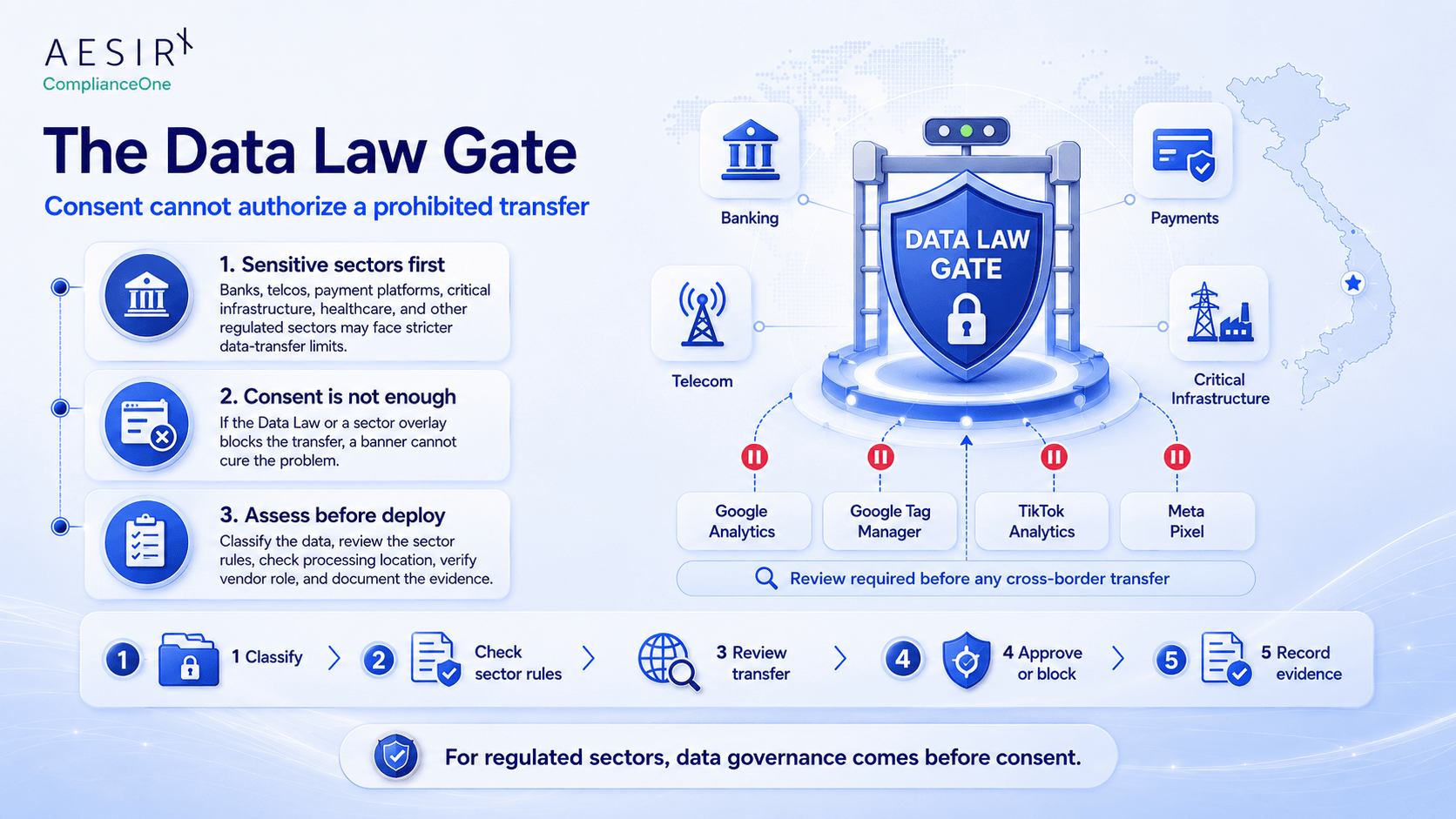
If a dataset is classified as important data or core data, the organization cannot treat foreign analytics, advertising, tag-management, or data-processing platforms as ordinary website utilities.
The Data Law treats cross-border transfer and processing of core and important data broadly. It includes transferring data stored in Vietnam to systems outside Vietnam, transferring data to foreign organizations or individuals, and using platforms located outside Vietnam to process data.
That last point is critical for modern websites.
Using Google Analytics, Google Tag Manager, TikTok Pixel, Meta Pixel, LinkedIn Insight Tag, foreign cloud analytics, foreign customer-data platforms, foreign heatmap tools, or foreign advertising platforms may involve more than a consent choice.
It may involve using a platform outside Vietnam to process data collected in Vietnam.
For an ordinary corporate website, that may be a personal-data, consent, vendor, and cross-border-transfer assessment problem.
For a bank, telecom operator, payment platform, critical infrastructure provider, or another sector-regulated organization, it may become a Data Law gate.
In those cases, the question is not:
“Did the user click accept?”
The question is:
“Are we legally allowed to send or process this category of data through this foreign platform at all?”
If the answer is no, uncertain, or not yet assessed, consent does not cure the problem.
A user cannot consent an organization out of a separate legal restriction on data transfer, sector supervision, national-security protection, important-data handling, core-data handling, or regulated infrastructure obligations.
That is why consent governance and data governance have to meet.
A cookie banner may ask for permission to use analytics.
But a Data Law gate may say that this category of data, in this sector, under this processing model, cannot be routed through that foreign analytics platform without additional assessment, approval, localization, contractual controls, regulatory analysis, or a different technical architecture.
The practical implication is direct.
A retail website may decide whether Google Analytics or TikTok Pixel can run based on consent, vendor due diligence, cross-border transfer assessment, and evidence.
A bank should start from a stricter default: no third-party behavioral analytics or advertising pixels until the data classification, sector overlay, transfer model, vendor role, processing location, and supervisory position have been reviewed.
A telecom operator should take the same approach for subscriber portals, customer apps, service dashboards, login areas, support flows, and any page where usage data may connect to subscriber identity, account activity, service metadata, location, device identifiers, or communication-related behavior.
A payment platform should treat conversion pixels, remarketing scripts, behavioral analytics, and tag-manager containers as high-risk unless it can prove exactly what data is collected, where it goes, what it is used for, and why the transfer is permitted.
This is not anti-marketing.
It is governance.
The organization needs a decision gate before deployment:
- What sector are we in?
- What data does this page, app, or portal expose?
- Could the data be important data or core data?
- Does the tool process data outside Vietnam?
- Does the tool send data to a foreign organization?
- Does the tool collect behavioral, device, account, transaction, subscriber, or service-use data?
- Is the data linked to an account, cookie ID, advertising ID, session ID, IP address, device identifier, phone number, customer number, or login state?
- Is the tool used for profiling, retargeting, audience building, conversion measurement, or behavioral analytics?
- Has legal, privacy, cybersecurity, data governance, and the relevant sector owner approved the use?
- Is the evidence recorded?
If the organization cannot answer those questions, the tool should not go live.
“Consent is not a legal bypass. If the Data Law or a sector overlay blocks the transfer, the banner must not ask the user to approve what the organization is not allowed to do.”
That is why banks, telecom operators, payment platforms, and other regulated organizations should be extremely careful with Google Analytics, Google Tag Manager, TikTok analytics, Meta Pixel, LinkedIn Insight Tag, and similar foreign analytics or advertising technologies.
The operational answer may be to block them entirely on regulated properties.
It may be to use only first-party, self-hosted analytics.
It may be to separate public marketing pages from authenticated customer environments.
It may be to run analytics only through a Vietnam-hosted, first-party architecture.
It may be to exclude regulated data categories from tracking.
It may be to require legal sign-off before any tag can be published.
The exact answer depends on the sector, the data classification, the page context, the processing location, the vendor role, and the applicable regulatory overlay.
But the governance principle is clear.
Consent governance decides whether the user has given permission.
Data governance decides whether the organization is allowed to process or transfer the data in that way at all.
For regulated sectors, the second question must come first.
The Cybersecurity Law gate: consent cannot waive security obligations
There is a third limit to consent.
Cybersecurity.
Consent may authorize a defined personal-data processing purpose.
It may support a lawful basis for a specific analytics, advertising, personalization, or communication activity.
But consent does not allow an organization to weaken cybersecurity controls, bypass localization requirements, ignore authority-response obligations, expose personal data through unsafe tools, or use foreign digital services in a way that conflicts with Vietnam’s cybersecurity framework.
That distinction matters.
The new Law on Cybersecurity 2025 consolidates Vietnam’s cybersecurity regime into a single framework and takes effect on 1 July 2026. It replaces the 2015 Law on Cyberinformation Security and the 2018 Law on Cybersecurity, and is designed to strengthen the protection of national security, critical information systems, digital infrastructure, and personal data.
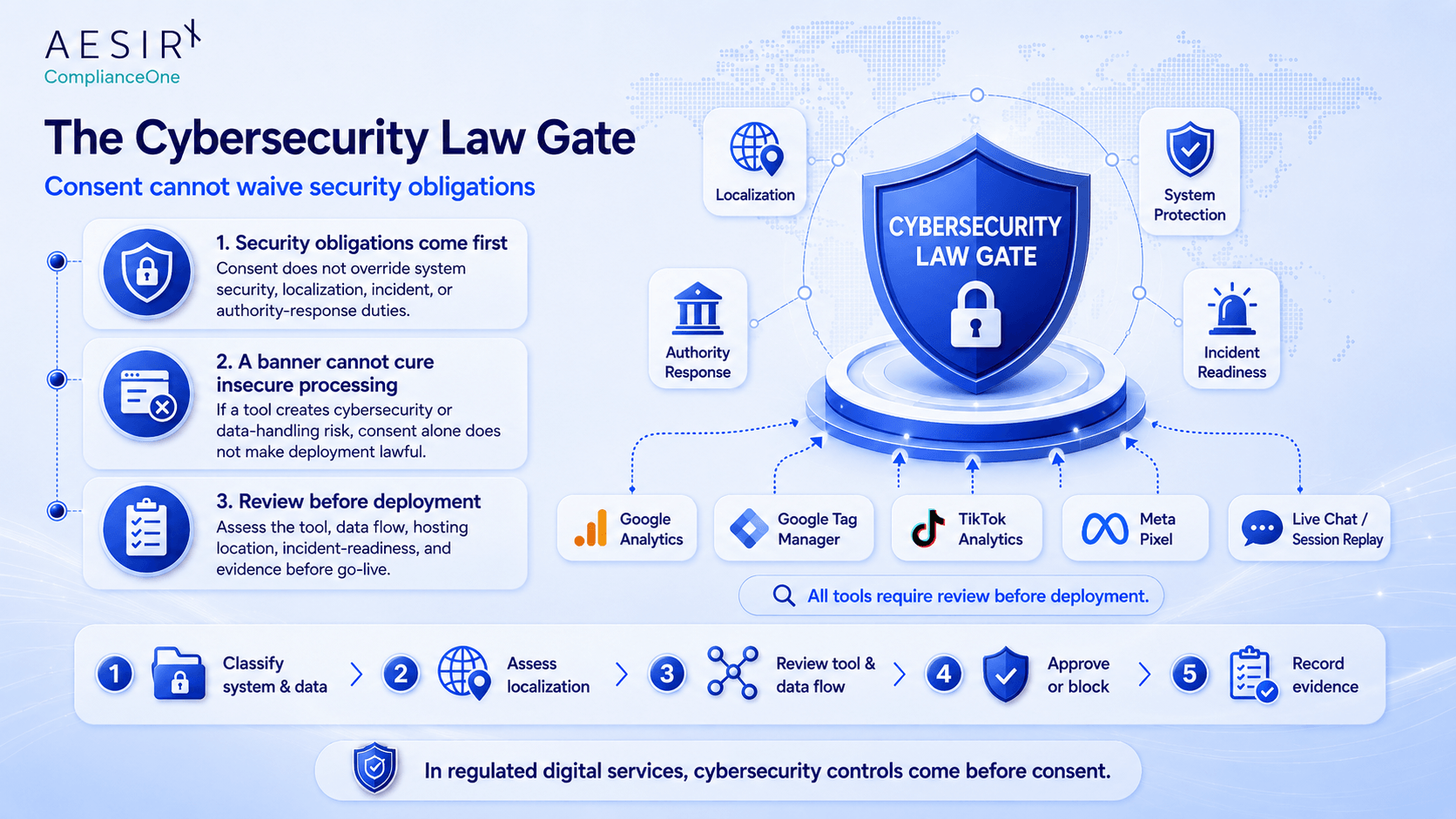
For consent governance, the practical lesson is simple:
A user cannot consent to an organization operating insecurely.
A customer cannot click “accept” and thereby permit a company to ignore cybersecurity controls.
A website visitor cannot consent to unlawful collection, transfer, exposure, leakage, or misuse of personal information.
A marketing team cannot rely on a banner to justify deploying a third-party script if that script creates cybersecurity, localization, incident-response, authority-cooperation, or prohibited-data-handling exposure.
That is why cybersecurity has to sit as a gate before consent deployment.
The Law on Cybersecurity 2025 is reported to retain data-localization requirements for relevant domestic and foreign enterprises providing services on telecommunications networks, the Internet, or value-added services in cyberspace in Vietnam where they collect, use, analyze, or otherwise process personal data, user relationship data, or data generated by users in Vietnam. It also introduces stronger time-bound obligations around providing user information and responding to enforcement requests in certain circumstances.
That changes how organizations should think about tools such as Google Analytics, Google Tag Manager, TikTok Analytics, Meta Pixel, YouTube embeds, live chat widgets, session replay tools, foreign CDPs, advertising networks, and cloud-hosted tracking platforms.
The question is not only:
“Did the user consent?”
The cybersecurity question is:
“Can this tool be used without violating our cybersecurity, localization, system-security, authority-response, incident-readiness, or data-protection obligations?”
For a simple public website, this may require a normal privacy, consent, vendor, and cross-border-transfer review.
For a bank, telecom operator, payment platform, critical infrastructure provider, public-service portal, healthcare platform, school system, or authenticated customer environment, the threshold should be much higher.
The organization should ask:
- Does this page or app process personal data, user relationship data, or user-generated data in Vietnam?
- Does the tool collect IP addresses, device identifiers, account identifiers, cookie IDs, session IDs, service-use metadata, or behavioral data?
- Does the tool send data to a foreign service provider?
- Does the tool process data outside Vietnam?
- Does the system fall within a regulated, critical, or high-risk operational environment?
- Could the tool weaken cybersecurity monitoring, incident containment, or evidence preservation?
- Would the organization be able to respond to an authority request within the required timeframe?
- Would the organization be able to preserve logs, prove configuration, and reconstruct the data flow?
- Has the cybersecurity, privacy, legal, and relevant sector owner approved the deployment?
- Is the decision recorded?
If those questions have not been answered, the tool should not go live.
Not because analytics is always illegal.
Not because consent is irrelevant.
But because consent is only one part of the legal stack.
“Consent can authorize a user choice. It cannot authorize a cybersecurity failure.”
This is especially important for tag managers.
A tag manager is not just a neutral container.
It is a control point that can load, block, sequence, change, or inject third-party scripts across a digital property.
If the tag manager is poorly governed, it can become a cybersecurity and compliance risk: new scripts can be added without privacy review, vendor behavior can change without legal approval, consent rules can drift, and evidence can become impossible to reconstruct.
For regulated organizations, that means tag governance is cybersecurity governance.
The practical control is straightforward.
Before deploying or changing analytics, pixels, embeds, tag-manager rules, live-chat scripts, or social tools, the organization should run a cybersecurity consent gate:
- classify the system and data;
- identify whether the tool collects personal, behavioral, relationship, service-use, or generated data;
- determine whether data is processed outside Vietnam;
- assess localization and sector requirements;
- review cybersecurity and incident-response implications;
- approve, block, or require first-party alternatives;
- record the decision and evidence.
In some cases, the answer may be approval with controls.
In other cases, the answer may be blocking the tool entirely.
In many regulated environments, the safer architecture may be first-party, self-hosted analytics, Vietnam-hosted processing, strict tag approval workflows, no behavioral advertising pixels on authenticated pages, and documented separation between public marketing pages and regulated customer environments.
That is the governance point.
Consent asks whether the user agreed.
Cybersecurity asks whether the organization is allowed to operate the system that way.
For regulated digital services, the second question must come first.
The AI Law gate: consent cannot authorize prohibited AI use
There is a fourth limit to consent.
Artificial intelligence.
Consent may allow an organization to process personal data for a defined purpose.
It may support analytics, personalization, customer support, fraud prevention, recommendation, or automation where the processing is lawful, transparent, necessary, and properly governed.
But consent does not allow an organization to use personal data in an AI system in a way that violates Vietnam’s AI Law, the Data Law, the Personal Data Protection Law, cybersecurity obligations, intellectual property rules, or sector-specific restrictions.
That distinction matters.
Vietnam’s Law on Artificial Intelligence regulates the research, development, provision, deployment, and use of AI systems. It also defines AI systems broadly as machine-based systems that infer from input data to generate outputs such as predictions, content, recommendations, or decisions that may affect the physical or digital environment.
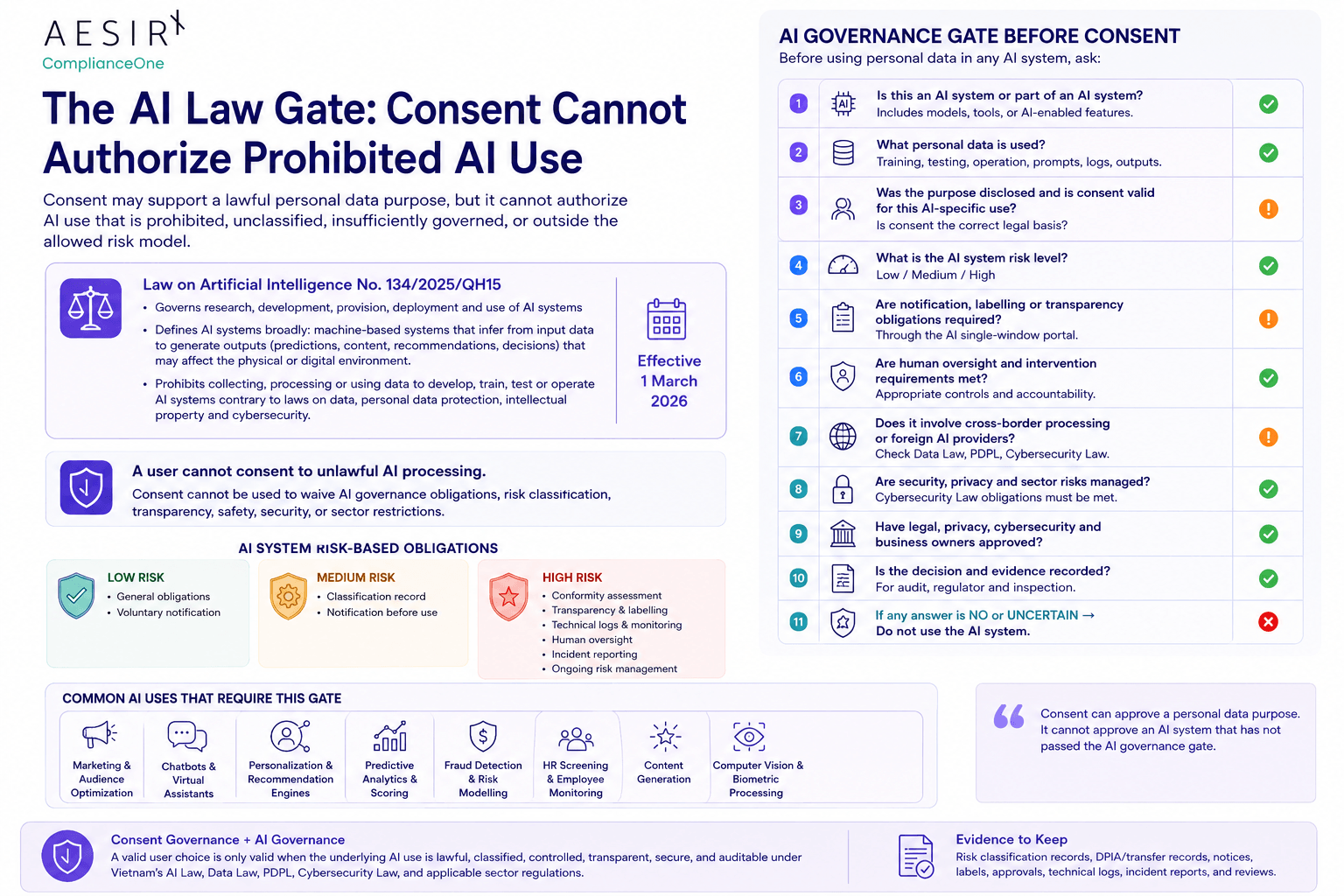
For consent governance, the practical lesson is simple:
A user cannot consent to unlawful AI processing.
A customer cannot click “accept” and thereby allow a company to train, test, fine-tune, profile, score, recommend, classify, or automate decisions using personal data outside the permitted legal framework.
A website visitor cannot consent to their behavioral data being repurposed into an AI model if that use was not properly disclosed, classified, governed, risk-assessed, and allowed.
An employee cannot be asked to “consent” to an AI-based HR scoring or monitoring system if the system has not been reviewed under the correct privacy, labor, data, cybersecurity, and AI governance rules.
A patient, student, borrower, subscriber, or platform user cannot waive the organization’s AI governance obligations merely by accepting a banner.
The AI Law makes this especially clear because it prohibits collecting, processing, or using data to develop, train, test, or operate AI systems contrary to the laws on data, personal data protection, intellectual property, and cybersecurity.
That creates an AI governance gate before consent can be relied on.
The question is not only:
“Did the user consent?”
The AI question is:
“Are we legally allowed to use this data in this AI system, for this purpose, at this risk level, under this governance model?”
That question applies to practical business tools:
Google Analytics data exported into an AI model.
TikTok or Meta campaign data used for AI audience optimization.
Customer-service chat logs used to train an AI assistant.
CRM records used for churn prediction.
HR data used for employee scoring or candidate screening.
Payment data used for fraud models.
Subscriber data used for behavioral prediction.
Education data used for student-risk analytics.
Healthcare data used for triage, diagnosis support, or patient segmentation.
Website behavior data used for personalization, profiling, recommendation engines, or automated targeting.
In each case, the organization should ask:
- Is this an AI system or part of an AI system?
- What personal data is used for training, testing, operation, prompting, logging, evaluation, or output generation?
- Was that purpose disclosed?
- Was consent valid for that AI-specific use?
- Is consent even the right legal foundation?
- Does the AI system need risk classification?
- Is it low, medium, or high risk?
- Does it require notification through the AI single-window portal?
- Does it require labelling or transparency controls?
- Does it require human oversight or intervention?
- Does it require incident reporting or technical logs?
- Does it use sensitive personal data, important data, core data, or regulated sector data?
- Does it involve a foreign AI provider, foreign infrastructure, or cross-border processing?
- Has legal, privacy, cybersecurity, data governance, and the business owner approved the deployment?
- Is the evidence recorded?
If those questions have not been answered, the system should not go live.
Not because AI is automatically unlawful.
Not because consent is irrelevant.
But because AI use creates its own governance layer.
Under the AI Law, AI systems are classified by risk level. Medium-risk and high-risk systems require classification records and notification before use, and high-risk systems are subject to conformity assessment and ongoing management obligations. The law also requires transparency for certain AI interactions and AI-generated or AI-modified content, and high-risk systems must maintain technical records, operational logs, risk controls, human oversight, data security, and accountability measures.
That means a banner cannot be the control.
Consent may be one input.
The AI governance record is the control.
“Consent can approve a personal-data purpose. It cannot approve an AI system that has not passed the AI governance gate.”
This matters for marketing and web teams because AI is increasingly embedded into ordinary digital operations.
A campaign platform may use AI for audience optimization.
A chatbot may summarize customer conversations.
A personalization engine may adjust content based on behavior.
An analytics platform may generate predictive segments.
A CRM may score leads automatically.
A support system may classify tickets, sentiment, or customer risk.
A recruitment tool may rank candidates.
A fraud system may flag transactions.
These are no longer just “software features.”
They may be AI systems or AI-supported processing environments.
The practical control is straightforward.
Before personal data is used in any AI-enabled tool, the organization should run an AI consent gate:
- identify the AI system or AI-enabled function;
- map the personal data used for training, testing, operation, prompts, logs, and outputs;
- confirm the purpose and legal foundation;
- classify the AI system by risk level;
- review whether notification, labelling, conformity assessment, or incident-readiness duties apply;
- assess cross-border, vendor, cybersecurity, and sector risks;
- approve, restrict, redesign, or block the use;
- record the evidence.
For some systems, consent plus governance may be enough.
For others, the organization may need stronger controls, a different architecture, human review, restricted data use, first-party processing, local hosting, de-identification, no model training, or a complete block.
The key is not to let consent become a shortcut.
Consent governance asks whether the user agreed.
AI governance asks whether the AI use is allowed, classified, controlled, transparent, and auditable.
For AI-enabled processing, the second question must come first.
The legal-basis gate: consent is not required when another legal foundation applies
There is a fifth consent lesson that is just as important.
Consent is not always required.
In many cases, consent is not even the right legal foundation.
A serious consent governance program does not ask for consent for everything. It classifies the processing activity and determines the correct legal foundation. Sometimes the correct answer is consent. Sometimes the correct answer is contract performance, legal obligation, state authority request, emergency protection, cybersecurity response, accounting retention, dispute handling, or another basis prescribed by law.
This distinction matters because asking for consent where consent is not the real legal foundation can mislead the data subject and weaken the organization’s governance position.
If the organization must process personal data to issue an invoice, maintain accounting records, process salary, respond to a lawful authority request, preserve breach evidence, handle a warranty claim, investigate fraud, or comply with tax and accounting obligations, the organization should not pretend that the processing depends on optional consent.
The user cannot meaningfully withdraw consent from an invoice that the company is legally required to issue and retain.
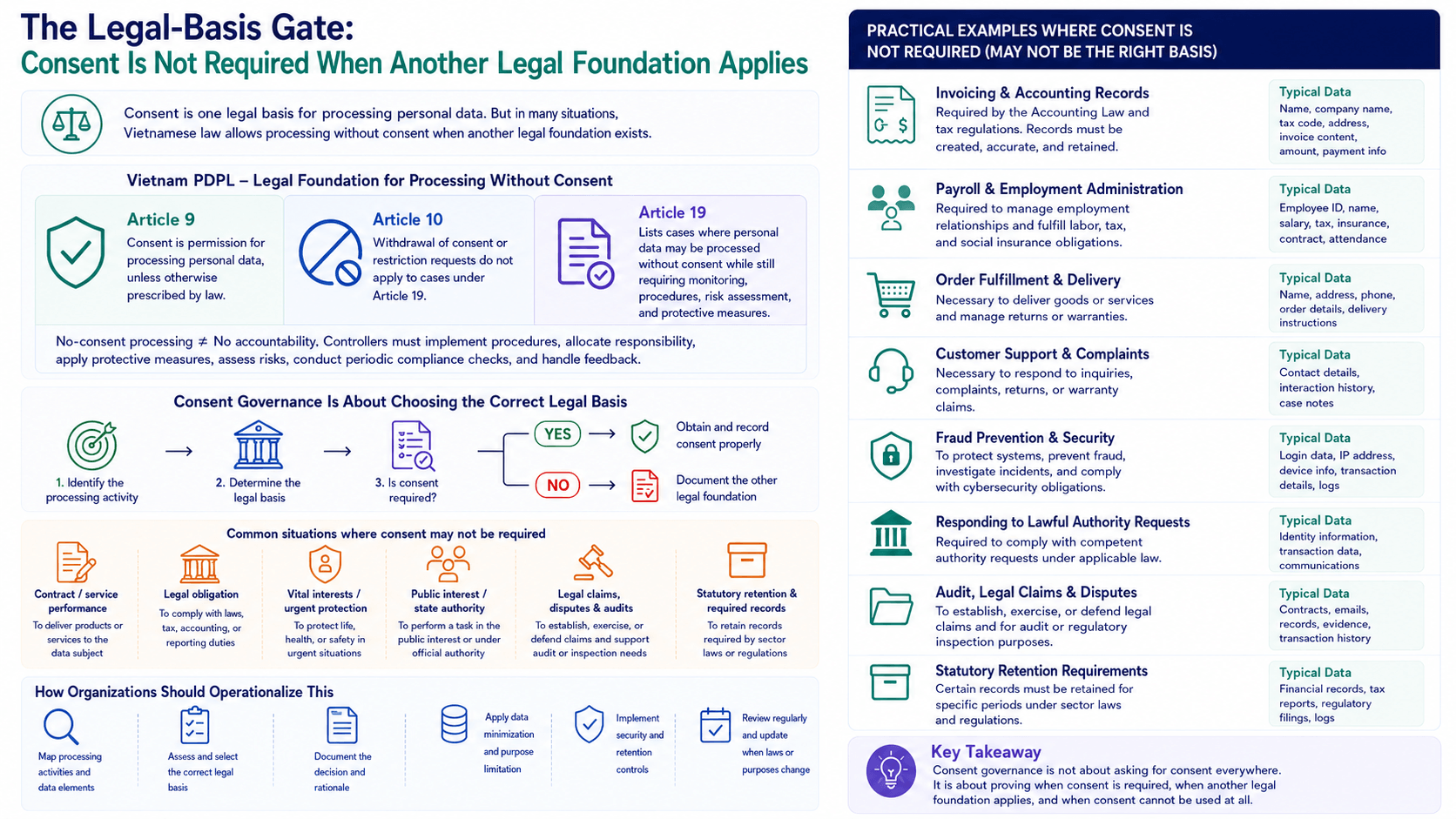
Vietnam’s Accounting Law requires accounting records to be made for economic and financial transactions and requires them to be clear, complete, timely, and accurate. Electronic accounting records must also be stored safely and remain accessible during the required retention period.
That makes invoicing a useful practical example.
When a customer buys a service, the company may need to process the customer’s name, company name, tax code, address, payment details, invoice content, transaction value, and related records in order to issue, store, and account for the invoice.
That processing should be governed.
It should be protected.
It should be limited to what is necessary.
It should have a retention rule.
It should be mapped in the data inventory.
It should be available for audit.
But it should not be treated as optional marketing consent.
The same principle applies across everyday operations.
A company may not need consent to:
- create and retain invoices and accounting records required by law;
- process payroll, tax, and statutory employment records;
- maintain transaction records needed for payment reconciliation;
- process delivery details needed to fulfill an order;
- handle returns, warranties, complaints, or customer-support cases;
- preserve security logs needed for fraud prevention or incident response;
- respond to lawful requests from competent authorities;
- retain evidence needed for audits, disputes, legal claims, or regulatory inspections;
- process data necessary to protect life, health, lawful rights, or urgent interests in the cases allowed by law.
That does not mean the organization can process freely.
No-consent processing is not no-governance processing.
Under the PDPL, when consent is not required, the organization still needs procedures, responsibility allocation, protective measures, risk assessment, periodic compliance checks, and mechanisms to receive and handle feedback and recommendations.
The practical question is therefore not:
“Can we avoid consent?”
The practical question is:
“What legal foundation applies, and can we prove it?”
For each processing activity, the organization should be able to show:
- why consent is required or not required;
- which legal foundation applies instead;
- which personal data is necessary;
- which system processes it;
- who owns the record;
- how long it is retained;
- who can access it;
- whether it is shared with vendors or authorities;
- whether it crosses borders;
- whether the data subject has been informed where required;
- what evidence proves the decision.
“Consent governance is not asking for consent everywhere. It is proving when consent is required, when another legal foundation applies, and when consent cannot be used at all.”
This is where many cookie and privacy programs go wrong.
They treat consent as the universal answer.
It is not.
Consent is one legal mechanism inside a larger governance model.
For analytics, advertising, tracking, behavioral profiling, social pixels, embedded media, and optional marketing, consent may be central.
For invoices, payroll, security logs, regulatory records, statutory retention, and lawful authority cooperation, another legal foundation may apply.
For prohibited transfers, insecure processing, ungoverned AI use, or sector-restricted data handling, consent may not be available at all.
That is why the consent record has to connect to the data map, processing-purpose register, vendor review, retention schedule, cross-border transfer assessment, cybersecurity review, AI governance record, and audit trail.
A banner can ask for permission.
A governance system decides whether permission is the right legal foundation.
The compliance gap: policy says one thing, browser does another
Last week’s audit-readiness article argued that compliance fails when the document says one thing, the system does another, and the evidence is missing.
Consent is one of the clearest examples.
The privacy policy may say non-essential cookies require consent.
The banner may appear to offer choices.
The internal policy may say advertising tags are blocked until opt-in.
But the browser may tell a different story.
A third-party script loads before choice.
A tag manager fires before the user acts.
An embedded video creates a third-party request.
A tracking pixel appears on a landing page not covered by the main policy.
A CMP setting changes but the internal consent policy is not updated.
A vendor is reclassified by marketing but not reviewed by privacy.
A withdrawal is recorded in the CMP but not propagated to the CRM, email platform, analytics tool, advertising audience, or downstream vendor.
That is where consent governance starts to break.
But the gap is not only technical.
Even when the banner works and the script is blocked until consent, the organization still has to prove that the wider governance decision was correct.
Was the tracker classified properly?
Was the behavioral data treated as sensitive-data governance where required?
Was the vendor reviewed?
Was the transfer assessed?
Was the cybersecurity exposure considered?
Was AI use involved?
Was consent actually the right legal foundation?
Was consent legally available at all?
That is the part many organizations miss.
Cookie compliance is not only a legal-policy exercise.
It is technical.
And it is operational.
It lives in cookies, pixels, scripts, tags, CMP settings, consent signals, analytics tools, marketing platforms, vendor configurations, data maps, legal-basis decisions, cross-border transfer reviews, cybersecurity controls, AI-governance records, and the evidence trail behind every classification decision.
The compliance team may understand the law.
The marketing team may understand the tools.
The web team may understand the implementation.
But consent governance fails when nobody owns the bridge between them.
“Do not claim consent compliance from the privacy policy. Prove it from the browser, the record, the governance decision, and the audit trail.”
This is the compliance gap that matters.
The document says one thing.
The browser does another.
The governance record is missing.
And when the evidence is missing, consent becomes an assumption.

Marker 1: purposes and legal foundations must be governed, not improvised
Consent governance starts with purposes.
But it does not stop there.
A consent banner that groups everything under broad labels such as “analytics,” “marketing,” or “personalization” may look organized, but the real question is whether those purposes are defined, approved, mapped, maintained, and connected to the correct legal foundation.
What does analytics mean?
Which analytics tool?
Which data categories?
Which vendors?
Which countries?
Which processing activity?
Which retention period?
Which consent signal?
Which downstream systems?
Which legal foundation?
Which evidence proves the configuration?
The purpose catalog is the heart of consent governance.
Without it, the organization cannot reliably decide what belongs under each consent category. It cannot explain why a tool is strictly necessary, analytics, functional, advertising, embedded media, security-related, or blocked entirely. It cannot map the user’s choice to actual processing. It cannot defend the configuration when a regulator, auditor, enterprise customer, bank, investor, or legal team asks for proof.
At scale, purpose governance has to become version-controlled.
When a purpose changes, the organization should know:
what changed;
who requested the change;
who reviewed it;
which properties are affected;
which vendors and scripts are affected;
whether the banner text changed;
whether the privacy notice changed;
whether consent is required;
whether another legal foundation applies;
whether consent is not legally available;
whether existing consent remains valid;
whether users need to be asked again;
whether a DPIA, transfer assessment, cybersecurity review, AI governance review, or sector review is triggered;
whether the change has gone live;
whether the live CMP state matches the approved governance decision.
This is why consent cannot be managed only in the CMP.
The CMP enforces the choice at the interface.
The GRC system governs the purpose, the legal foundation, the approval, the evidence, and the change history.
Marker 2: the live implementation must match the approved governance decision
The second maturity marker is implementation alignment.
Many organizations approve a privacy policy once, configure a banner once, and then allow the website to evolve around it.
That is dangerous.
Marketing adds a pixel.
An agency installs a new analytics tool.
A developer embeds a video.
A product team launches a new landing page.
A tag manager rule changes.
A CMP template is copied from another property.
A new vendor enters the stack.
An AI-enabled personalization tool is activated.
Nothing malicious has to happen.
The system simply drifts.
Consent drift is the gap between what the organization approved and what the live digital property actually does.
But after Vietnam’s new legal stack, the gap is not only between policy and banner.
It is between the approved governance decision and the real implementation.
At scale, that drift has to be detectable.
The organization should be able to compare:
approved consent policy;
purpose catalog;
legal-basis decision;
CMP configuration;
live banner text;
live cookies and trackers;
tag manager behavior;
vendor list;
cross-border transfer status;
cybersecurity review status;
AI-use review status;
withdrawal mechanism;
privacy notice;
evidence history.
When those do not match, the issue should become a governance item, not an informal Slack message.
Someone should own it.
Someone should review it.
Someone should decide whether to update the policy, change the configuration, block the technology, reclassify the purpose, update the legal foundation, run a transfer review, require cybersecurity approval, trigger AI governance, or document an exception.
The evidence should remain connected.
“Consent drift is not a website bug. It is a governance failure.”
This is especially important for multi-property organizations: e-commerce groups, banks with campaign microsites, insurers with product pages, universities with admission portals, hospitals with booking systems, SaaS companies with apps and documentation sites, and multinational groups with local Vietnam properties.
One property may be compliant.
The group may not be.
Marker 3: withdrawals must propagate, not disappear
Consent governance is not complete when a user clicks “accept.”
It is tested when the user changes their mind.
Under Vietnam’s PDPL, data subjects may request withdrawal of consent or restriction of processing in relevant circumstances, and the controlling party or controlling-and-processing party must receive, implement, and request processors to implement those requests within the prescribed timeframe.
Operationally, this creates a difficult question.
Where did the consent go?
If a user withdraws consent in the CMP, does that choice stay only in the website banner state?
Does it reach the CRM?
Does it reach the marketing automation platform?
Does it update advertising audiences?
Does it affect analytics identifiers?
Does it remove the user from personalization segments?
Does it notify the vendor owner?
Does it update downstream processors?
Does it create a task?
Does it produce evidence?
Can the organization prove the withdrawal was received and acted on?
This is where many consent programs fail.
They record the click but not the propagation.
A withdrawal that never reaches downstream systems is not operationally complete.
At scale, withdrawal propagation needs a workflow.
The organization should know:
when the withdrawal was received;
which purpose or processing activity it affected;
which systems and vendors relied on that consent;
which downstream actions were required;
who owned each action;
when each action was completed;
whether any exception applied;
whether another legal foundation still required limited processing;
what evidence proves completion.
That last point matters.
Withdrawal does not always mean every related record disappears. Some records may still need to be retained for invoicing, accounting, security, audit, dispute handling, legal obligation, or regulatory evidence.
That is why the withdrawal workflow has to connect with the legal-basis decision.
Consent withdrawal must propagate where consent was the foundation.
But where another legal foundation applies, the organization has to explain why limited processing continues.
This cannot depend on a spreadsheet.
It has to be part of the consent governance model.
Marker 4: high-risk processing needs stronger governance gates
Not all consent decisions are equal.
Some processing is higher risk because of the data category, the data subject, the purpose, the technology, the sector, the transfer model, or the legal framework that applies.
Health data, biometric data, children’s data, employee data, financial data, location data, behavioral tracking, advertising profiling, AI-assisted scoring, cross-border transfers, subscriber data, payment data, and regulated-sector data all raise different governance questions.
The organization should not treat every consent policy change as the same operational event.
Some changes should require stronger review.
A marketing-purpose change may need privacy review.
A children’s-data consent process may need legal review and business-owner approval.
A biometric processing purpose may need a DPIA review.
A cross-border vendor receiving consent-linked personal data may need a transfer assessment.
A behavioral tracking tool may trigger sensitive-data governance under Decree 356.
A foreign analytics or advertising platform may trigger a Data Law and sector review before it can be used.
A tag manager, pixel, or third-party script may require cybersecurity review before deployment.
An AI-enabled tool may require AI-system classification, transparency controls, risk assessment, or stronger approval before personal data can be used.
A sensitive-data workflow may need stricter evidence retention.
A high-risk change may need board or senior management visibility.
This is where consent governance connects to the wider GRC platform.
Consent does not live alone.
It touches DPIAs, data mapping, vendor governance, cross-border transfer assessments, cybersecurity review, AI governance, rights requests, breach response, policy management, audit trails, and regulatory inspection readiness.
The banner is only the surface.
The risk lives in the processing.
“Consent can approve a user choice. It cannot bypass the governance gates that decide whether the processing is allowed.”
Marker 5: consent evidence must prove the full chain
The final maturity marker is evidence.
A mature consent program can prove the full chain.
Not just that a user clicked something.
Not just that a banner existed.
Not just that a privacy policy was published.
It can prove the governance state around consent.
That includes:
approved policy version;
approved purpose catalog;
legal-basis decision;
live CMP configuration;
vendor and tracker inventory;
script and tag behavior;
pre-consent blocking status;
user choice record;
withdrawal record;
downstream propagation record;
sensitive-data classification;
cross-border transfer review;
cybersecurity review;
AI-use review;
change approvals;
mismatch reconciliation;
scan history;
evidence pack;
audit trail.
The organization should be able to answer:
What was the banner configuration on a specific date?
Which purposes were active?
Which vendors were mapped to those purposes?
What loaded before the user made a choice?
Which consent state was recorded?
Which withdrawal requests were received?
Which downstream systems were updated?
Who approved the last change?
Was consent required?
Was another legal foundation used?
Was consent unavailable because another legal or sector gate blocked the processing?
Was behavioral tracking classified correctly?
Was the Data Law transfer question reviewed?
Was cybersecurity review required?
Was AI governance triggered?
Which evidence proves the live implementation matched the approved governance decision?
That is consent governance at scale.
“A consent record is not audit-ready until it can explain the policy, the technology, the user choice, the legal foundation, the downstream effect, and the proof.”
From CMP deployment to consent governance
A CMP is necessary.
But a CMP is not the whole governance model.
The CMP presents choices, stores signals, and enforces behavior at the consent layer.
The GRC system connects that consent layer to regulatory obligations, internal policies, data processing records, vendor records, data classifications, cross-border transfer reviews, cybersecurity controls, AI-system governance, approvals, evidence, risk decisions, and audit trails.
The difference is important.

CMP deployment asks:
Does the banner appear?
Consent governance asks:
Does the banner reflect the approved policy?
Does the policy reflect the actual processing?
Does the actual processing match the live website, app, portal, or campaign page?
Does the user’s choice reach downstream systems?
Can the organization prove it later?
But in Vietnam’s new regulatory environment, the governance question goes one step further.
Was consent required?
Was another legal foundation more appropriate?
Was the data behavioral, sensitive, important, core, regulated-sector, cybersecurity-relevant, or AI-related?
Was the organization even allowed to process, transfer, track, retain, or use the data in that way?
That is the part a CMP cannot decide alone.
A CMP can help collect and enforce a user choice.
It cannot determine whether the underlying processing model is lawful, whether a Data Law gate applies, whether a cybersecurity review is required, whether AI governance obligations are triggered, or whether a sector-regulated organization should block the tool entirely.
The first question is technical deployment.
The second set of questions is compliance operations.
Vietnamese organizations need both.
A banner can collect permission.
A governance system decides whether permission is the right legal foundation — and whether permission is legally available at all.
How ComplianceOne Turns Consent Into Operational Proof
AesirX ComplianceOne treats consent as part of the operational GRC layer, not as a standalone banner function.
That matters because consent does not live alone.
A consent decision touches the processing purpose, the data category, the vendor, the digital property, the CMP configuration, the legal foundation, the withdrawal path, the cross-border transfer model, the cybersecurity posture, the AI-use case, and the evidence trail behind every change.
The Consent Governance module is designed to centralize that operating model. It connects approved consent policies to live consent operations through version-controlled policies, purpose cataloging, refusals, withdrawals, restrictions, objections, CMP enforcement, drift detection, configuration snapshots, change awareness, audit trails, withdrawal propagation tracking, sensitive-data consent policies, reconciliation between internal consent records and live CMP state, and bidirectional synchronization with AesirX CMP Pro.
The Consent Properties module extends the same governance model across websites, apps, portals, campaign pages, and digital services. It supports property registration, consent groups, policy bindings, change requests, cross-property comparison, inconsistency detection, golden templates, group rollout confirmation, property consent analytics, and evidence packs.
The point is not that a platform makes consent easy.
The point is that a platform makes consent governable.
When a consent purpose changes, the change can be reviewed.
When a banner drifts from the approved policy, the mismatch can be detected.
When a withdrawal arrives, downstream propagation can be tracked.
When a vendor, script, pixel, tag manager, analytics tool, AI system, or digital property changes, the decision can be assessed against the wider compliance model.
That wider model matters.
Some processing requires consent.
Some processing relies on another legal foundation.
Some processing must be blocked regardless of consent because the underlying transfer, cybersecurity exposure, AI use, sector restriction, or data classification makes it impermissible or too high-risk without further controls.
That is why ComplianceOne connects consent governance with data mapping, vendor risk, cybersecurity review, AI-system classification, incident readiness, evidence capture, audit trails, and sector overlays.
A user choice is only valid when the underlying processing model is also lawful, controlled, and provable.
This is how consent moves from banner management to operational proof.
A practical maturity model for consent governance
An organization can test its consent governance maturity with five questions.

Most companies can answer some of these.
Few can answer all of them without manual reconstruction.
That is the opportunity.
Consent governance is not about adding more bureaucracy.
It is about removing ambiguity.
Consent Proof Is Becoming a Commercial Requirement
Consent governance is not only a regulatory issue.
It is a trust issue.
Enterprise customers ask whether tracking is controlled.
Investors ask whether compliance risk is visible.
Banks ask whether data processing is documented.
Auditors ask whether evidence exists.
Legal teams ask whether consent can be defended.
Boards ask whether the organization knows its exposure.
Marketing teams need clarity on what they are allowed to run.
Web teams need clear rules that do not change informally.
DPOs need evidence without chasing screenshots.
Executives need confidence that the organization is not relying on a banner as a legal shield.
But after Vietnam’s new legal stack, the commercial question is no longer only whether consent was collected.
It is whether the organization can prove that consent was the right mechanism in the first place.
A serious buyer, investor, regulator, bank, or enterprise customer may ask:
Can you prove that behavioral tracking was classified correctly?
Can you prove that Google Analytics, Google Tag Manager, TikTok Pixel, Meta Pixel, or similar tools do not load before consent where consent is required?
Can you prove that withdrawals propagate beyond the banner?
Can you prove that regulated-sector data is not routed through foreign analytics or advertising platforms without a Data Law, sector, and cross-border transfer review?
Can you prove that cybersecurity, localization, incident-readiness, and authority-response obligations were considered before deploying third-party scripts?
Can you prove that personal data was not used in AI systems without AI governance, risk classification, transparency, and approval?
Can you prove when consent was required, when another legal foundation applied, and when consent could not be used at all?
That is why consent governance is becoming part of commercial readiness.
For Vietnamese companies preparing for PDPL implementation, Decree 356 procedures, Data Law obligations, cross-border data reviews, sector supervision, cybersecurity requirements, AI governance, international expansion, enterprise procurement, or board-level risk reporting, the ability to prove the consent chain becomes a market signal.
The company that can show a banner proves only that a banner exists.
The company that can show purpose governance, vendor mapping, legal-basis decisions, withdrawal propagation, pre-consent blocking evidence, cross-border review, cybersecurity gates, AI-use review, and audit trail sends a different signal.
It shows operational control.
And in regulated markets, operational control is what serious buyers, banks, boards, and regulators increasingly expect.
What Europe Already Taught About Banner-Level Compliance
Vietnam is the primary regulatory focus for this article, but the operational lesson is familiar to companies already dealing with GDPR and ePrivacy in Europe.
The EU experience showed that cookie banners alone do not solve consent governance.
Companies still struggled with dark patterns, pre-consent loading, unclear purposes, vendor sprawl, advertising tags, consent-mode configuration, withdrawal handling, and evidence gaps.
The important distinction is that Europe separates the legal analysis into layers.
Under GDPR, personal-data processing may rely on different legal bases depending on the context. In some cases, organizations argue that a processing activity can rely on legitimate interests. But that does not automatically mean tracking technologies can load without consent.
For cookies, pixels, SDKs, tag managers, and similar technologies, the ePrivacy layer often asks a different question first:
Are we storing information on the user’s device or accessing information from it?
If yes, consent may be required unless a narrow exception applies, such as where the technology is strictly necessary to provide a service the user requested.
That is why many European companies failed even when they had privacy policies, CMPs, and legal-basis language. They treated the banner as the compliance layer instead of connecting the banner to the actual tracking behavior.
A privacy policy said one thing.
The browser did another.
The consent record did not prove the chain.
Vietnam should not copy the GDPR “legitimate interests” framing into PDPL analysis. Vietnam’s Personal Data Protection Law has its own structure: consent, withdrawal and restriction rules, and defined situations where processing may occur without consent when another legal foundation applies.
That makes the operational lesson even more important.
The question is not whether the organization can borrow EU terminology.
The question is whether the organization can prove the correct Vietnamese compliance path:
- consent is required and was properly captured;
- consent is not required because another legal foundation applies;
- consent is not available because another law, sector rule, Data Law gate, Cybersecurity Law gate, or AI Law gate blocks the processing;
- the live technology matches the approved governance decision.
The same lesson applies in Vietnam.
A banner is not a compliance program.
A consent string is not a governance model.
A policy page is not proof.
The organization needs a connected system that links consent to processing purposes, vendors, trackers, data categories, legal foundations, withdrawal flows, approvals, monitoring, and audit-ready evidence.
That is the common denominator across serious privacy regimes.
The terminology differs.
The operating requirement is the same:
prove the consent chain, prove the legal foundation, and prove that the technology follows the governance decision.

From Consent Assumption to Consent Proof
Consent governance at scale begins when the organization stops asking whether the banner exists and starts asking whether the decision can be proven.
Can we prove what was shown?
Can we prove what the user chose?
Can we prove which purpose applied?
Can we prove what loaded before choice?
Can we prove which systems received the signal?
Can we prove that withdrawal propagated?
Can we prove the policy matched the implementation?
Can we prove who approved the last change?
But after Vietnam’s new legal stack, the question goes further.
Can we prove whether consent was the correct legal foundation?
Can we prove whether the processing could proceed without consent because another legal foundation applied?
Can we prove whether behavioral tracking triggered sensitive-data governance under Decree 356?
Can we prove whether the Data Law created a transfer gate before the banner could even ask?
Can we prove whether the Cybersecurity Law required security, localization, incident-readiness, or authority-response controls first?
Can we prove whether AI use was classified, governed, and allowed before personal data was used in an AI system?
Can we prove when consent was required, when consent was not required, and when consent could not be used at all?
That is the standard.
Not because compliance teams want more process.
Because consent without proof becomes a legal assumption.
And consent used in the wrong place becomes a governance failure.
A banner can ask for permission.
It cannot decide whether the organization is allowed to process, transfer, track, secure, retain, or use the data in that way.
That decision belongs in the governance layer.
This is the shift from cookie banners to operational proof.
The organization must prove the consent chain, prove the legal foundation, prove the technical behavior, and prove that the wider regulatory gates were respected.
Assumptions do not survive inspection.
If you want to see how consent governance works as part of an operational GRC platform - across policies, purposes, CMP state, digital properties, withdrawals, drift detection, evidence packs, and audit trails - you can explore AesirX ComplianceOne at:
https://aesirx.io/compliance-one
Ronni K. Gothard Christiansen
Technical Privacy Engineer & CEO, AesirX.io
Laws, regulations, and frameworks referenced
- Luật Bảo vệ dữ liệu cá nhân (PDPL): Vietnam Personal Data Protection Law, Law No. 91/2025/QH15, referenced for consent, withdrawal / restriction requests, collection of personal data, processing without consent where another legal foundation applies, advertising-related personal data processing, online communication services, cookies, do-not-track style controls, and inspection readiness.
- Nghị định 356/2025/NĐ-CP: Referenced for consent mechanics, implementation procedures, sensitive personal data categories including behavior/activity tracking in cyberspace, and the wider operational layer around PDPL compliance.
- Luật Dữ liệu: Vietnam Data Law, Law No. 60/2024/QH15, referenced for digital data governance, important data, core data, cross-border data transfer and processing, use of foreign platforms to process data collected in Vietnam, and the sector-level governance gate that may apply before consent can be relied on.
- Luật An ninh mạng: Vietnam Law on Cybersecurity, including the 2025 consolidated framework taking effect on 1 July 2026, referenced for cybersecurity obligations, system protection, authority cooperation, incident readiness, data localization, personal-data protection in cyberspace, and the principle that consent cannot waive security, localization, or prohibited-data-handling obligations.
- Luật Trí tuệ nhân tạo: Vietnam Law on Artificial Intelligence, Law No. 134/2025/QH15, effective 1 March 2026, referenced for AI-system governance, risk classification, transparency, labelling, high-risk AI management, incident handling, inspection readiness, and the principle that consent cannot authorize the use of personal data in AI systems beyond what the AI, data, personal-data-protection, cybersecurity, and sector rules allow.
- Nghị định 142/2026/NĐ-CP: Decree detailing and guiding implementation of the Law on Artificial Intelligence, issued 30 April 2026 and effective 1 May 2026, referenced for the implementation layer around AI risk classification, notification procedures, labelling, serious incident reporting, conformity assessment, high-risk AI-system management, and sandbox mechanisms.
- Luật Kế toán: Vietnam Accounting Law, Law No. 88/2015/QH13, referenced as an example of a separate legal foundation for processing and retaining accounting records, invoices, transaction records, and related financial documentation where consent may not be the appropriate basis.
- Sector-specific rules and supervisory expectations: Relevant sector overlays may apply depending on the organization, including banking, insurance, telecom, healthcare, education, e-commerce, infrastructure, payments, energy, and other regulated or high-data-volume sectors.
- GDPR and ePrivacy Directive: Referenced as comparative international frameworks for consent, cookies, tracking technologies, transparency, lawful basis, and audit-ready evidence for organizations operating across jurisdictions or serving international customers.
Disclaimer
This article is for informational purposes only and does not constitute legal advice.
It discusses consent governance, cookie-banner operations, CMP alignment, withdrawal propagation, evidence management, regulatory mapping, website tracking, and audit preparation from a technical and compliance-operations perspective. It should not be treated as a final legal interpretation of any individual organization’s obligations, compliance status, filing duties, cross-border transfer position, cybersecurity posture, sector-specific obligations, or enforcement exposure.
This article also discusses situations where consent may not be required, where another legal foundation may apply, and where consent may not be legally available because of Data Law, Cybersecurity Law, AI Law, sector-specific, statutory-retention, or other regulatory constraints.
Organizations should obtain qualified legal advice before making regulatory filings, data protection impact assessments, cross-border transfer assessments, consent-policy decisions, cookie-classification decisions, vendor-risk decisions, data-classification decisions, breach-notification decisions, or enforcement-risk conclusions.
AesirX ComplianceOne and AesirX CMP Pro can support compliance work, consent governance, evidence management, regulatory mapping, workflow execution, audit preparation, and chain-of-custody documentation. They do not replace qualified legal counsel, the responsible DPO, the compliance function, internal audit, risk management, board oversight, or human review and approval of compliance evidence, assessments, filings, and decisions.
Frequently Asked Questions About Consent Governance at Scale
A website scanning tool such as the AesirX Privacy Scanner can help establish a baseline by identifying cookies, trackers, scripts, beacons, and third-party technologies active on the website before deeper governance review begins. Scan your site here: https://aesirx.io/services/privacy-scanner
Then decide whether consent is required, whether another legal foundation applies, or whether the processing must be blocked. After that, document the approved policy, map vendors and transfers, block non-essential tools before consent where required, track withdrawals, review high-risk tools, and keep evidence that proves the live implementation matches the governance decision.


