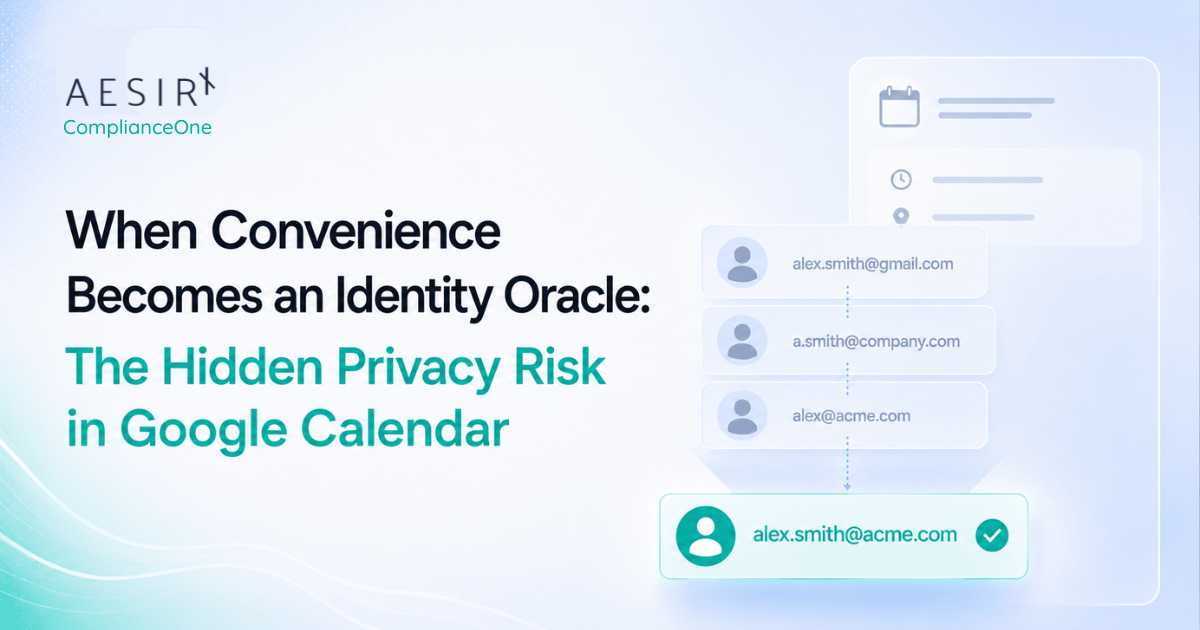
TL;DR: Google Calendar’s guest field may do more than help users select the right contact: it can potentially turn guessed email addresses into confirmed identity records by revealing a name, profile image, or other identity signal before an invitation is sent. In the age of AI-enabled browser automation, a feature designed for human convenience can become infrastructure for scalable email validation, identity enrichment, phishing, and profiling. The deeper issue is not the avatar itself, but whether platforms should allow personal data to confirm speculative identifiers without the affected person’s knowledge. Privacy by design must now account for how ordinary interface features can be automated, combined, and repurposed at machine scale.
For years, I have noticed a seemingly helpful feature in Google Calendar.
When creating an event and entering someone’s email address as a guest, Google will often display that person’s profile image, name, or avatar before the invitation is sent.
In an ordinary situation, this feels useful. It helps the organiser confirm that the correct person has been selected and reduces the risk of inviting the wrong contact.
But viewed through a privacy, data-protection, and abuse-prevention lens, the same feature raises a more difficult question:
Should an unverified email address be enough to retrieve identity information about a person who has never interacted with you?
The issue is not simply that Google displays profile images.
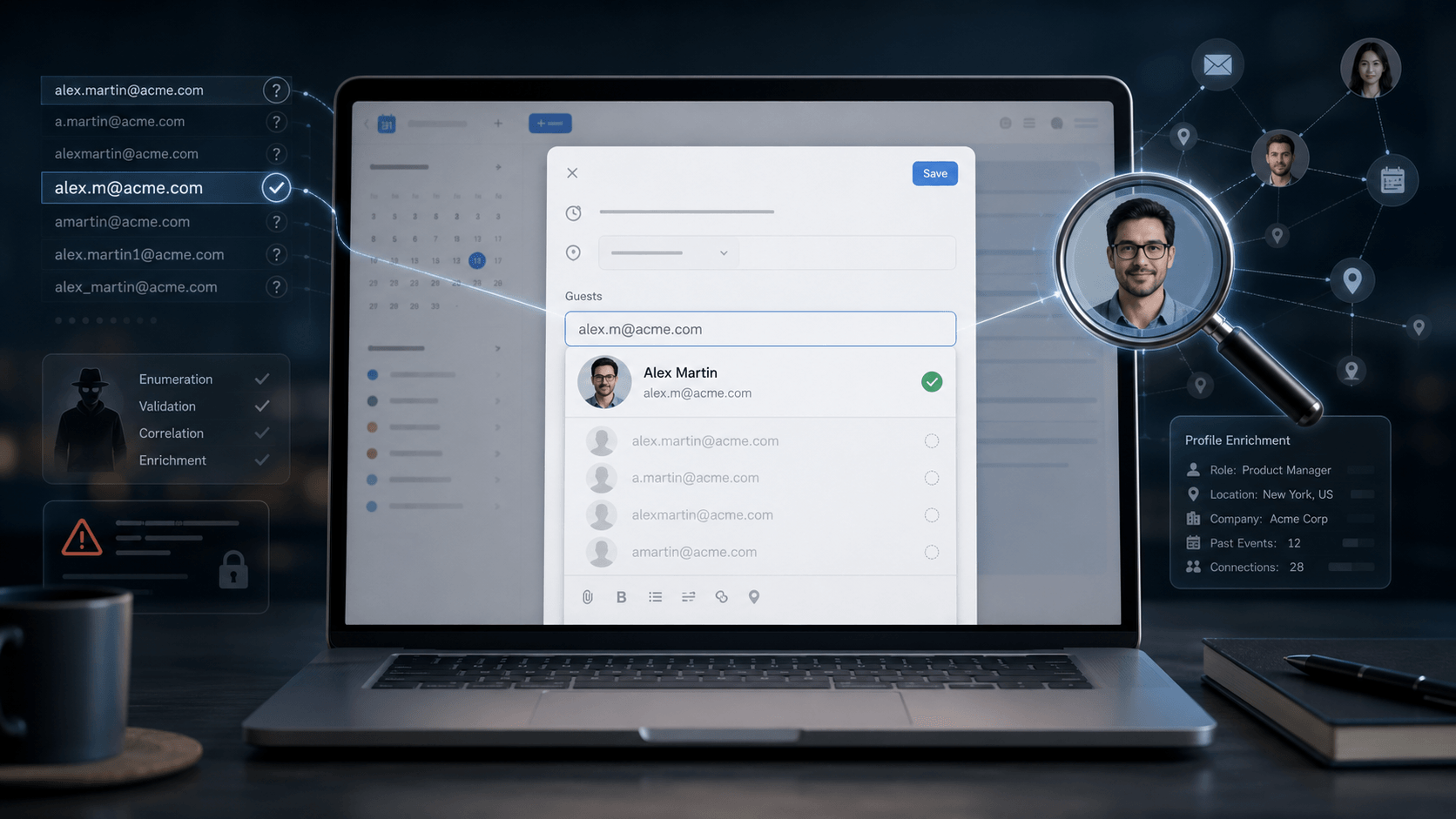
The issue is that Google may be validating a guessed email address and enriching it with identity data before any communication, invitation, acceptance, or relationship has been established.
That turns a convenience feature into something potentially more powerful: an identity-resolution oracle.
From Contact Recognition to Contact Discovery
There is an important difference between recognising someone whose contact details you already know and discovering someone’s contact details through repeated guessing.
Consider a common scenario.
An attacker knows:
- A person’s name;
- The company they work for;
- The company’s email domain;
- A few common corporate email formats.
They may not know whether the person’s address is:
- firstname.lastname@company.com;
- firstname@company.com;
- firstinitial.lastname@company.com;
- firstname.lastname1@company.com.
Ordinarily, these are only guesses.
But if entering one of those guesses into Google Calendar causes a recognisable photograph or profile name to appear, the attacker may now have confirmation that:
- The address is associated with a Google-recognised identity;
- The address likely belongs to the intended person;
- The guessed corporate email format is correct;
- The address can be used for targeted communication.
The platform has not merely displayed an image. It has helped convert speculative data into verified identity information.
“The platform has not merely displayed an image. It has helped convert speculative data into verified identity information.”
Why This Matters More in the Age of AI
This type of behaviour may have existed for years.
What has changed is the cost of exploiting it at scale.
A human could manually test a handful of email addresses. That would be slow, tedious, and limited.
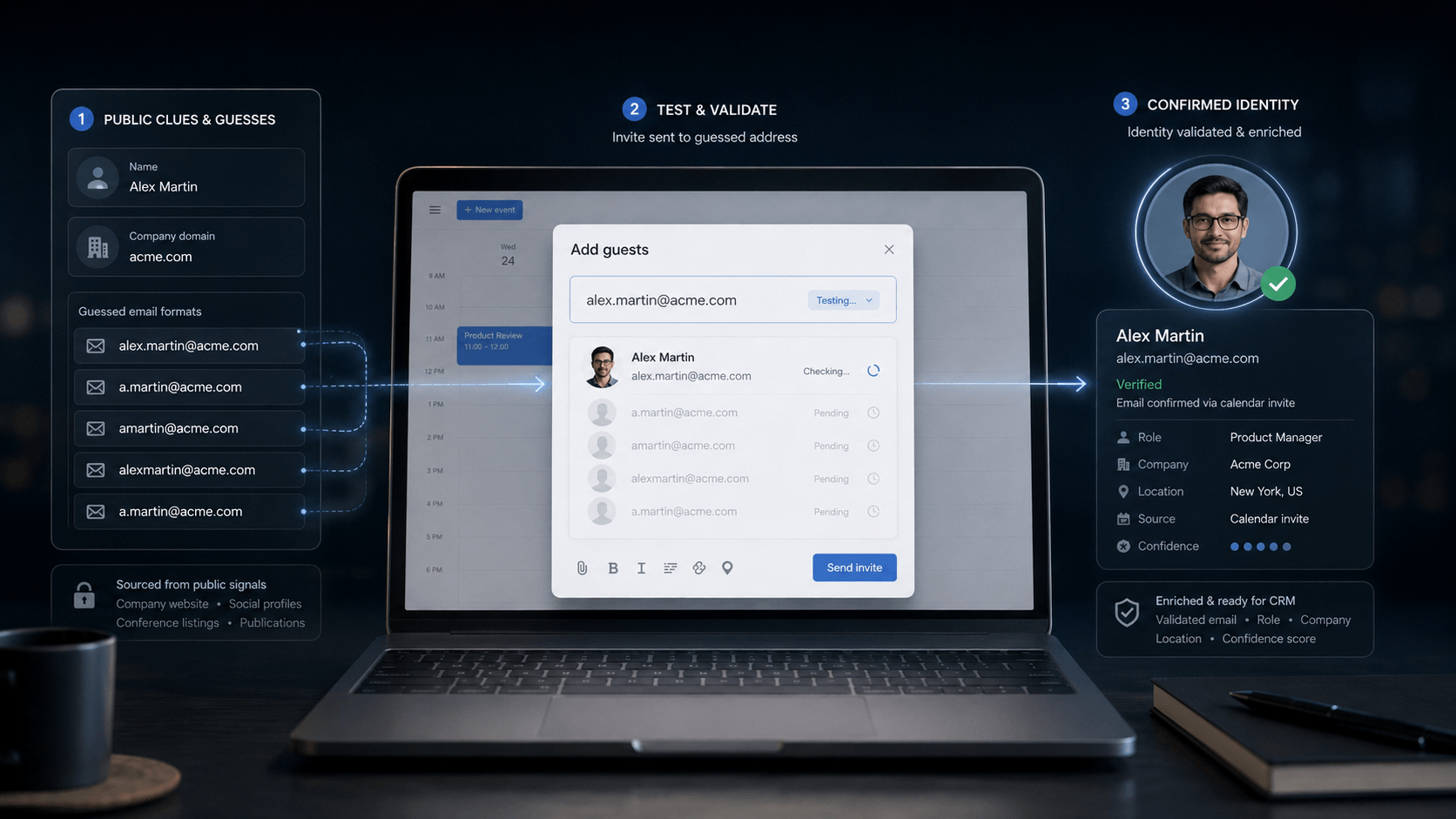
An AI-enabled browser agent can potentially perform the same ordinary interface actions repeatedly:
- Generate likely email addresses;
- Enter a candidate into the Calendar guest field;
- Wait for the identity result;
- Record the returned name or image;
- Remove the candidate;
- Continue with the next address.
No sophisticated hacking technique is necessarily required. The agent may simply interact with the interface in the same way as a normal user.
“Artificial intelligence does not need to create a new vulnerability to transform risk. It can make an existing design weakness economically practical.”
Public company websites, LinkedIn profiles, conference attendee lists, press releases, staff directories, and regulatory filings already provide much of the source material needed to generate candidate identities.
Google Calendar may then provide the validation layer.
This matters because artificial intelligence does not need to create a new vulnerability to transform risk. It can make an existing design weakness economically practical.
The security question is therefore no longer:
Could a person manually misuse this feature?
It is:
Can automated systems repeatedly use the feature to validate and enrich identity data at a scale that was not realistically possible when the feature was designed?
The Affected Person May Never Know
One of the most concerning elements is that the person whose identity is being resolved may receive no notification.
The event does not need to be sent.
The target does not need to accept anything.
There may be no email, calendar invitation, login alert, or other visible indication that their address was tested and their image displayed.
The affected person may therefore have no practical ability to know:
- Who looked them up;
- Which email address was tested;
- How many times their identity was resolved;
- Whether the result was recorded;
- Whether the information was combined with other data;
- Whether the lookup was part of a legitimate invitation or a harvesting workflow.
This creates an asymmetry.
The requesting party receives information. The affected person receives no equivalent transparency.
A Privacy Setting Does Not Resolve the Underlying Design Question
Google offers profile-discovery and visibility settings that may affect what other people can see.
Those controls are relevant, but they do not fully answer the broader concern.
Most ordinary users are unlikely to think of their Google profile image as part of an email-validation system. Many may not know that a profile-discovery setting exists, where to find it, or how it affects Calendar guest suggestions.
More importantly, the fundamental issue is not only whether a user’s photograph is technically configured as discoverable.
The issue is whether a platform should allow discoverable identity attributes to be used as confirmation signals for speculative identifiers.
There is a meaningful distinction between:
- Displaying a profile image during a legitimate interaction; and
- Returning that image to someone repeatedly testing possible email addresses.
A privacy control focused only on visibility may fail to address abuse at the workflow level.
Privacy by design requires more than giving users a setting. It also requires anticipating how product features can be combined, automated, and repurposed.
“A privacy control focused only on visibility may fail to address abuse at the workflow level.”
The Data-Protection Problem is Correlation
A name or photograph may already be publicly available somewhere else.
That does not mean a new correlation is harmless.
A photograph on a professional profile and an unconfirmed corporate email address are separate pieces of information. When a platform connects them, the resulting dataset becomes more valuable.
The risk comes from correlation:
- Name linked to email;
- Email linked to employer;
- Email linked to a face;
- Face linked to public profiles;
- Profile linked to role and authority;
- Role linked to likely access, responsibilities, or payment authority.
This enriched record can support:
- Targeted phishing;
- Executive impersonation;
- Supplier fraud;
- Business email compromise;
- Spam-list validation;
- Employee directory creation;
- Harassment or stalking;
- De-anonymisation of secondary accounts;
- Cross-platform identity matching.
Data protection is not only concerned with whether each individual piece of data is secret.
It is also concerned with what becomes possible when information is combined.
Purpose Limitation and User Expectations
A person may upload a profile image so colleagues can recognise them in Gmail, Meet, Drive, or other collaborative services.
That does not necessarily mean they expect the same image to help unknown parties validate guessed email addresses.
This raises a purpose-limitation question.
Information provided for one understandable purpose, identity within a communication or collaboration environment, may be functioning as part of a separate identification and validation mechanism.
The legal analysis will vary across jurisdictions, but the engineering principle is universal:
A feature should not quietly expand the practical use of personal data beyond what users would reasonably understand from the original context.
The most important question is not whether a platform can technically show the image.
It is whether the disclosure is proportionate, necessary, transparent, and resistant to foreseeable misuse.
Security and Privacy Cannot Be Separated
This example also demonstrates why privacy and security should not be treated as separate disciplines.
The disclosed information may appear low risk when assessed one attribute at a time:
- An email address;
- A name;
- A profile image;
- An employer.
But combined with automation, these attributes can become part of an attack-enablement system.
A privacy weakness can lower the cost of a security attack.
A security control such as rate limiting can become a privacy safeguard.
A product-design decision can affect phishing risk.
An identity feature can become an enumeration mechanism.
This is why modern governance cannot rely only on privacy notices and user settings. It requires technical controls that govern what systems actually disclose, under which conditions, and at what scale.
What Privacy-Respecting Design Could Look Like
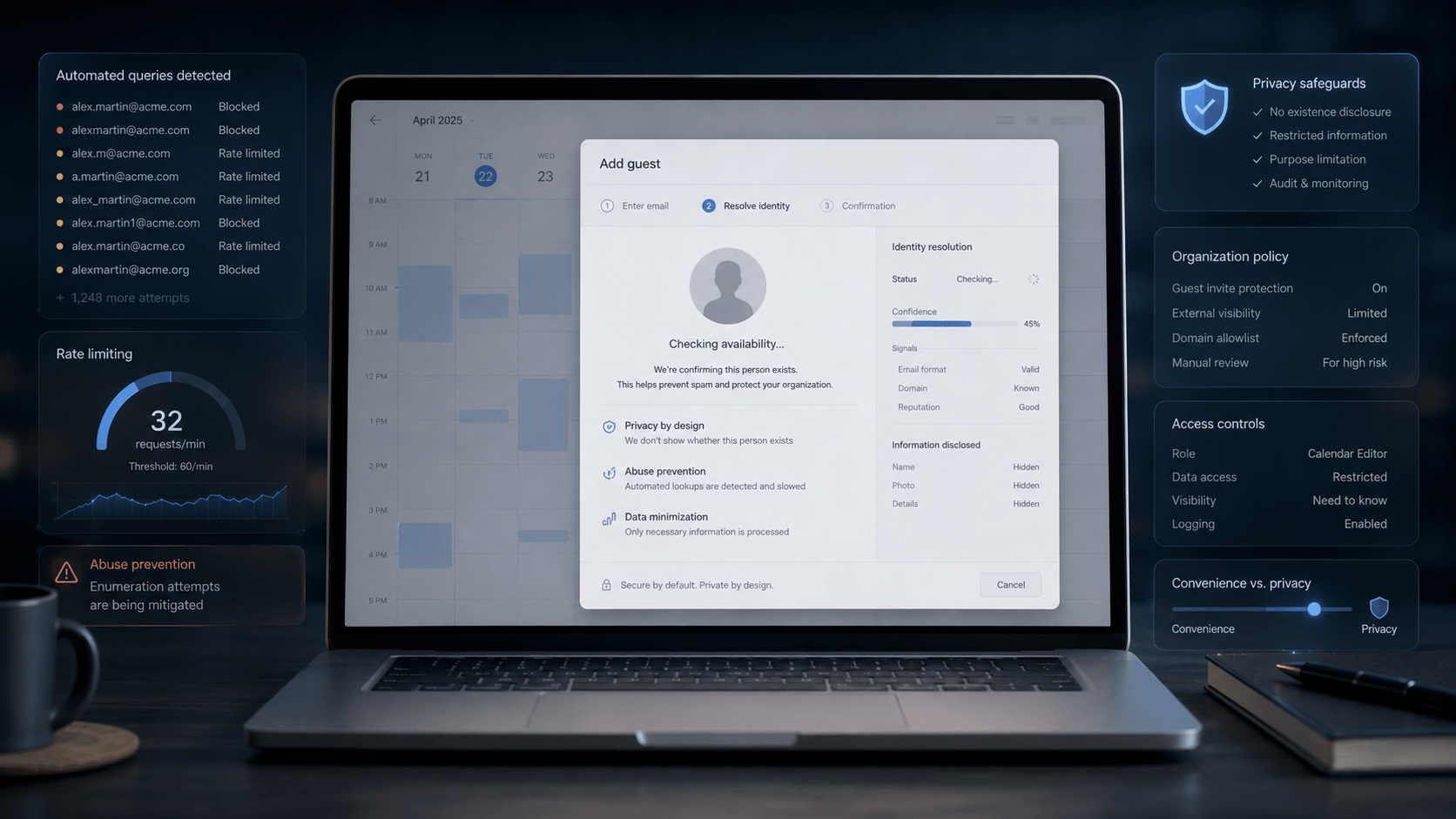
Google and other platforms offering similar identity-resolution features could reduce the risk without removing the useful Calendar experience entirely.
Possible safeguards include:
1. Delay identity disclosure
Display a generic avatar until the event is sent, accepted, or another legitimate interaction occurs.
2. Introduce relationship-based disclosure
Show detailed profile information only where the organiser and invitee have an existing relationship, such as previous communication, a saved contact, a shared organisation, or an accepted collaboration.
3. Prevent reliable validation
Avoid making valid and invalid candidate addresses visually distinguishable before an invitation is sent.
4. Apply behavioural rate limits
Detect repeated addition and removal of unrelated addresses, especially within a single unsent event.
5. Add progressive friction
Introduce warnings, delays, CAPTCHA challenges, temporary restrictions, or other safeguards when behaviour resembles enumeration rather than event planning.
6. Provide Calendar-specific controls
Allow users to determine whether their photograph or full identity can be shown to unknown external organisers before an invitation is sent.
7. Improve transparency
Explain clearly that profile information may appear when another person enters the user’s address into Google services.
8. Give organisations control
Workspace administrators should be able to limit external profile discovery for employees, particularly in sectors exposed to impersonation, fraud, or targeted social engineering.
A Wider Lesson for AI-era Product Governance
The broader lesson extends beyond Google Calendar.
“Every identity-disclosing workflow should be evaluated not only as a user interface, but also as a potential machine-queryable signal.”
Many digital products contain features that were designed for human-scale convenience:
- Contact suggestions;
- Username availability indicators;
- Profile previews;
- Password-reset messages;
- Autocomplete;
- People-search functions;
- Invitation workflows;
- Account-recovery hints.
At low volume, these features may appear harmless.
At machine scale, they can become infrastructure for enumeration, enrichment, profiling, or targeting.
This creates a new requirement for privacy and security teams:
Every identity-disclosing workflow should be evaluated not only as a user interface, but also as a potential machine-queryable signal.
Organisations should ask:
- Can this feature validate whether a person or account exists?
- Does it return more information than the requester supplied?
- Can the operation be repeated without the affected person knowing?
- Can an automated agent perform the workflow?
- Are rate limits designed for current AI-enabled automation?
- Does the feature correlate information from different contexts?
- Would users reasonably expect this use of their data?
- Is there an audit trail or transparency mechanism?
- Can the same benefit be achieved with less disclosure?
These questions belong in privacy impact assessments, abuse-case analysis, threat modelling, and product-governance reviews.
The Real Issue is Not the Avatar
The photograph is only the visible part of the problem.
The deeper issue is whether a global platform can be used to convert guessed identifiers into verified identity records without the affected individual’s knowledge.
A convenience feature may be entirely legitimate in its intended context while still creating an unintended abuse pathway.
That does not automatically mean the feature is an exploitable vulnerability. It does mean the design deserves scrutiny.
“The real privacy question is not only what information is visible, but what someone can systematically infer, confirm, and build from it.”
In the AI era, privacy risk increasingly emerges not from a single dramatic data breach, but from ordinary product features that become powerful when automated and combined.
The question for platforms is therefore no longer only:
Is this information visible?
It must also be:
What can someone systematically infer, confirm, and build from the fact that it is visible?
That is where privacy by design must evolve next.
Ronni K. Gothard Christiansen
CEO & Technical Privacy Engineer, AesirX.io
Laws and Standards Referenced
- European Union: General Data Protection Regulation (GDPR), Articles 5, 25, and 32 (including Recital 75).
- International: ISO/IEC 31700-1:2023, Privacy by Design for Consumer Products and Services.
- International: NIST Privacy Framework 1.0.
- International: OECD Privacy Guidelines (2013).
Disclaimer
This article reflects technical and privacy engineering analysis of publicly observable product behaviour. It is intended for educational and discussion purposes only and should not be interpreted as legal advice, a finding of regulatory non-compliance, or confirmation of a security vulnerability. References to laws, standards, and privacy principles are provided to explain potential governance considerations. Whether a particular implementation complies with applicable legal requirements depends on the specific technical design, configuration, jurisdiction, and factual circumstances.


