TL;DR: Electronic labor contract governance is an evidence problem spanning the agreement lifecycle, parties, identity and signature evidence, employee-data safeguards, provider connection, platform synchronization, and filing receipts. Decree 337/2025/NĐ-CP is the central decree governing electronic labor contracts, effective 1 January 2026. Circular 08/2026/TT-BNV provides detailed implementing procedures, effective 1 July 2026.
The standard connected workflow has two separate 24-hour clocks: provider dispatch after final signing and Platform ID processing after receipt of a compliant contract. Resolution 44 permits eligible providers to continue while awaiting connection through 31 December 2026. Qualifying contracts retain paper-equivalent legal value through their term and follow the Ministry’s pre-July ID procedure.
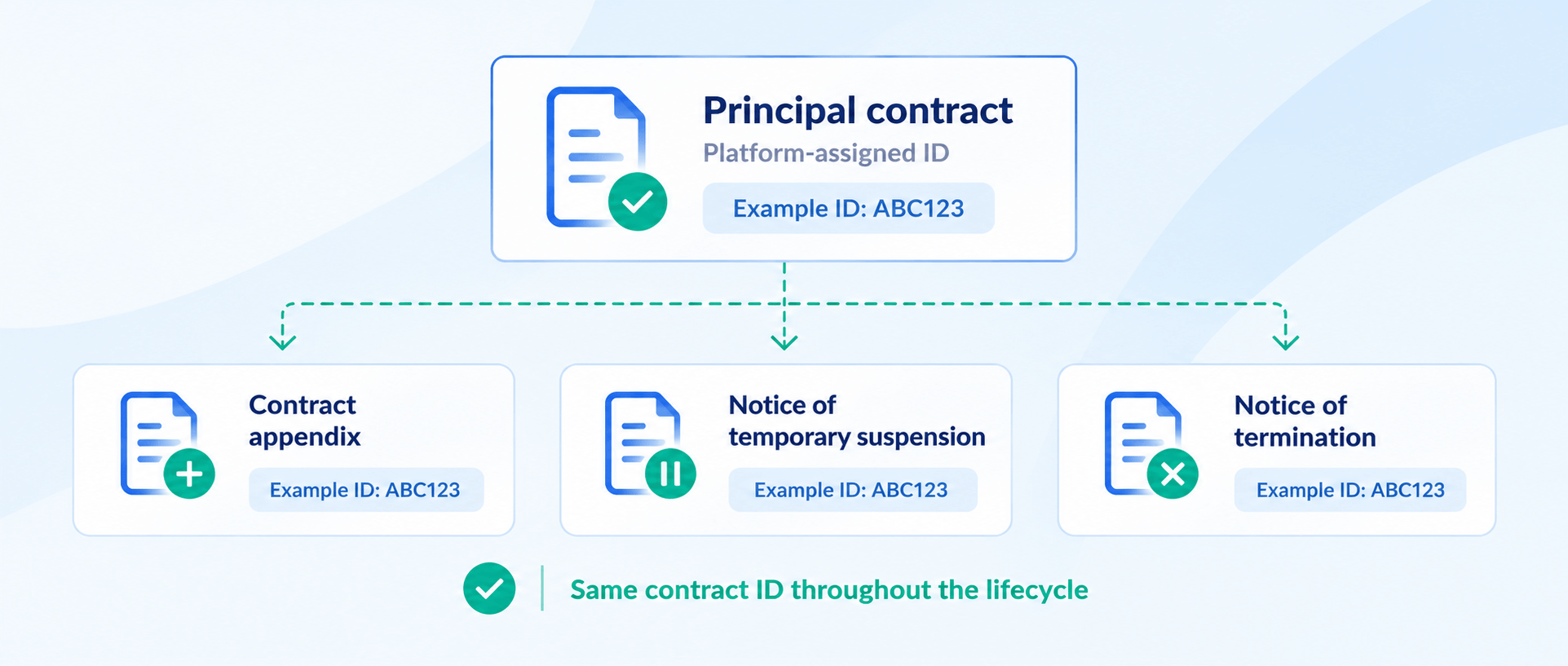
Lifecycle documents retain the principal contract ID. Provider assurance, statutory retention and employee-data safeguards complete the evidence chain.
ComplianceOne records what responsible providers and organizations did. It does not conclude or sign contracts, transmit them to the Ministry of Home Affairs platform, assign contract identification codes, determine legal validity, verify signatures, duplicate identity attribute values in structured trust-evidence fields, or hold key material. Four verified official Circular 08 artifacts must remain clearly separated from internal working templates.
An HR director is asked to demonstrate the history of one electronic labor contract.
The signed agreement is in the contract provider's service. Identity evidence sits with another provider. A signature-verification report is attached to an email. The HR system knows the employee. A synchronization receipt may exist, but the team cannot immediately say whether the latest attempt succeeded. An appendix carries a reference that nobody can trace back to the principal contract without opening several systems.
Every team may have performed its job correctly. The organization still struggles to prove the relationship between those acts.
That is the operational challenge behind Vietnam's electronic labor contract stack. Decree 337/2025/NĐ-CP is the central decree governing electronic labor contracts. Issued on 24 December 2025, it took effect on 1 January 2026. Circular 08/2026/TT-BNV, issued on 15 May 2026 and effective on 1 July 2026, provides detailed implementing procedures for contract IDs, Platform access, connection, synchronization, data use and reporting.
The broader legal framework includes the Labor Code 2019, Electronic Transactions Law 20/2023/QH15, Decree 23/2025/NĐ-CP on electronic signatures and trust services, and Circular 19/2025/TT-BKHCN where trust-service technical-audit evidence is relevant. Decree 337 does not sit above these instruments. The official Decree 337 record and Circular 08 record confirm their issue and effective dates.
ComplianceOne packages Decree 337 and Circular 08 as a connected cross-sector electronic-labor-contract overlay. Its process-based evidence model connects the regulated parties to the supporting systems and services used in their contracting process.
ComplianceOne does not replace eContract, trust-service, identity, HR or government-platform systems. It provides the governance layer connecting the electronic labor contract lifecycle to parties, provider assurance, signature and identity evidence, synchronization, official submissions, employee-data obligations and audit history.
Govern electronic labor-contract evidence without replacing the systems that sign and transmit the contract.
My view is that organizations should treat the contract, its parties, the signature evidence, the identity-verification evidence, the platform synchronization trace, and the employee-data safeguards as one connected evidence story.
Connected does not mean performed by one platform. The trust boundary must remain clear. A compliance platform can record evidence about signatures, identities, credentials, filings, and synchronization. It should not claim to perform any of those regulated or technical acts.
The Contract File Is Not the Evidence Chain
A PDF or electronic artifact can show the text agreed by the parties. It may not answer the wider governance questions:
- Who are the parties as governed identities or organizations?
- Which signature evidence relates to each party?
- What identity-verification event occurred, by which method and provider?
- Which credential was relied on, and what was its lifecycle status at the relevant time?
- Which employee-data safeguards apply to the contract process?
- Which provider carried the platform synchronization duty?
- What was the outcome of each synchronization attempt?
- Which submission channel carried a connection request or service report?
- What receipt or payload evidence came back?
- Which later appendix, notice of temporary suspension, or termination notice relates to the principal contract?
The contract artifact matters, but the evidence chain explains how the organization relied on it.
A spreadsheet can list a contract and current status. It rarely preserves the full history of credentials, verification evidence, synchronization attempts, amendments, and receipts in connected records.
Applicability Follows the Regulated Role; Evidence Follows the Process
Decree 337 applies directly to employees and employers concluding or performing electronic labor contracts, and other relevant agencies, organizations and individuals. Circular 08 expressly includes employees, employers, eContract providers and other agencies, organizations and individuals connected to implementation.
Direct regulated roles include employees, employers, eContract providers and relevant Platform participants, with each duty mapped to its responsible actor. Supporting HRIS, payroll, identity, signature, trust-service and other systems may supply evidence or process data without automatically carrying a particular Decree 337 duty. Merely storing contract or employee data does not make every HR technology vendor directly responsible for those duties.
An organization does not need to belong to a particular industry for this framework to matter. Teams should assess their actual contracting activities, regulated roles and provider responsibilities. ComplianceOne's process-based scoping is an operational evidence model, not a replacement for the statutory scope test.
Decree 337 and Circular 08 Have Different Jobs
Decree 337 supplies the central electronic-labor-contract framework. It defines an electronic labor contract as having legal value equivalent to a written paper labor contract within that statutory framework.
Article 7 provides that the contract becomes effective when the final party signs digitally, timestamps are attached to the parties' digital signatures, and the eContract provider certifies the data message, unless the parties agree another effective time.
Circular 08 supplies detailed procedures for IDs, connection, data use, Platform access, reporting, synchronization and traceability. ID issuance does not change the contract's conclusion, content or effective time. Synchronization and ID issuance do not themselves create legal validity.
ComplianceOne does not determine whether the statutory conditions for legal validity have been met. Decree 337 supplies the legal framework and effectiveness conditions. ComplianceOne preserves evidence around parties, signatures, certification, identity, provider actions and lifecycle to support the organization's record and any later legal review. The same discipline applies to identity and signatures. Recording that another service verified a signature is not the same as ComplianceOne verifying it. Recording evidence about a person's identity attribute does not require storing the attribute's value.
The Temporary Transition Under Resolution 44
Resolution 44/2026/NQ-CP took effect on 30 October 2026, with Article 1(1) applying from 1 July 2026. An eContract provider that was already offering electronic labor contract services before 1 July 2026 and had not completed its Platform connection by that date may continue providing those services while awaiting connection, through 31 December 2026.
Qualifying contracts concluded during that period have the same legal value as written paper labor contracts through the end of their term, subject to labor and electronic-transactions law. Their identification codes follow the Ministry of Home Affairs’ procedure for contracts concluded before 1 July 2026. The end of the transition does not cut short the term of a qualifying contract.
The Platform must begin official operation no later than 15 December 2026. That is a launch deadline, separate from the end of the provider transition. From 1 January 2027, the conclusion of new electronic labor contracts must meet the conditions and methods in Article 6 of Decree 337.
ComplianceOne does not determine whether the statutory conditions for legal validity have been met. Decree 337 supplies the legal framework and effectiveness conditions. ComplianceOne preserves evidence around parties, signatures, certification, identity, provider actions and lifecycle to support the organization's record and any later legal review. The same discipline applies to identity and signatures. Recording that another service verified a signature is not the same as ComplianceOne verifying it. Recording evidence about a person's identity attribute does not require storing the attribute's value.
Four Official Artifacts, Nine Internal Working Templates
Circular 08 is the only instrument in this overlay with verified official artifacts. Four are included:
- Mẫu số 01 – Request by an eContract provider to connect to the Electronic Labor Contract Platform.
- Mẫu số 02 – Request by an information-system/database owner to connect to the Platform.
- Appendix III – Request to exploit/share data on the Electronic Labor Contract Platform.
- Appendix IV – Report on provision of electronic labor contract conclusion services.
Appendix II is the data catalog for the Electronic Labor Contract Platform. It remains a reference/data schema and is not counted as a submission form.
Nine additional lifecycle, synchronization, and cross-link templates are platform-prepared working documents. They help teams organize evidence. They are not authority-issued artifacts and must remain labeled accordingly.
No verified official form is currently seeded for Decree 337 itself.
This separation is not editorial detail. A reviewer needs to know whether a record uses a prescribed artifact, a source reference, or an internal aid. Blurring those categories can make an internal checklist appear to carry government authority.
Trust-Service Evidence Is Part of the Contract Story
Decree 337 requires qualifying eContract providers to meet technical and trust conditions, including the relevant trust-service authorization for data-message certification. That assurance connects the contract process to Electronic Transactions Law 20/2023/QH15, Decree 23/2025/NĐ-CP and Circular 19/2025/TT-BKHCN on technical audits.
Circular 08 Article 19 requires relevant eContract providers to submit technical-audit evidence for their data-message certification service: a certified copy of the valid technical-audit certificate with its audit report, within one year of account allocation or when previously submitted certification expires.
ComplianceOne can govern provider identity, applicable authorization/license evidence, expiry and review dates, technical-audit certificate/report evidence, accountable owners, exceptions and reassessment. The authoritative regulator, register or source remains controlling. ComplianceOne does not independently determine that a provider is licensed, qualified or trustworthy.
Connect Electronic Labor Contracts to the Wider Compliance Stack
The Labor Code 2019 remains part of the underlying employment framework. Assess each additional layer according to its own scope:
| Layer | Applicable framework and evidence context |
| Electronic transactions and trust | Electronic Transactions Law 20/2023/QH15, Decree 23/2025/NĐ-CP, Circular 19/2025/TT-BKHCN and applicable signature/timestamp technical standards supported by ComplianceOne. Preserve external signature, certification, timestamp and technical-audit evidence. |
| Identity and electronic identification | Identity Law 26/2023/QH15, Decree 69/2024/NĐ-CP and Decree 320/2026/NĐ-CP where relevant. ComplianceOne records verification performed elsewhere; identity systems authenticate individuals and access national services under their authority. |
| Personal data | Personal Data Protection Law 91/2025/QH15, Decree 356/2025/NĐ-CP and Decision 778/QĐ-BCA procedures where relevant to employee identity, employment records, biometric verification evidence, signatures and other personal data. |
| Data governance | Data Law 60/2024/QH15 and Decree 165/2025/NĐ-CP; other data instruments only where their actual scope is reached. |
| Cybersecurity | Cybersecurity Law 116/2025/QH15 and applicable implementing instruments, with evidence mapped to the relevant systems, operators and safeguards. |
Circular 08 requires Platform data processing and sharing to follow data, personal-data, cybersecurity and related requirements. Keep each framework's applicability and evidence separate. One electronic-contract record does not prove compliance with every layer.
A Seven-Part Evidence Model for Electronic Labor Contracts
A defensible operating record connects seven elements: the agreement, its party references, external signature and identity evidence, credential lifecycle, synchronization attempts, electronic submissions, and employee-data safeguards.
Each element should retain its own owner and history while pointing to the same contract context.
1. Register the Agreement and Its Lifecycle
The evidence model covers the principal electronic labor contract and its related lifecycle documents: contract appendix, notice of temporary suspension and notice of termination.
The record should identify the document type, parties, lifecycle stage, responsible owner, supporting evidence and relevant dates. Circular 08 provides one unique ID per electronic labor contract, issued once and unchanged when the contract is amended, supplemented, suspended or terminated. Appendices, suspension notices and termination notices use the same ID as the principal contract.
The platform does not create the official identification code. That code is assigned by the Electronic Labor Contract Platform. ComplianceOne records the identifier and relationship after it exists.
For qualifying contracts concluded while an eligible provider awaits connection under Resolution 44, use the Ministry of Home Affairs’ ID procedure for pre-July 2026 contracts. Record the official ID when it is assigned and link subsequent lifecycle documents to the principal contract.
This boundary matters because assigning a code is part of the external platform's authority and operation. A governance record must not imply that entering a value caused or validated the assignment.
2. Use Party References, Not Typed Names
An agreement's parties should reference governed people and organizations rather than rely only on typed names.
Typed names are fragile. Spelling differences can create duplicate parties. A changed organization name can break history. Signature evidence may become detached from the entity it is meant to support.
Entity references allow the agreement to connect the named party to evidence about signature and identity-verification events. They do not turn ComplianceOne into an identity provider or authentication service.
ComplianceOne's structured trust-evidence attribute record duplicates no national identity number, date of birth, tax reference, or hash of those values. It records evidence that a verification happened: attribute type, issuer, method, time, result, and protected attachment.
Prescribed government forms, external source records or protected attachments may themselves contain identity data where the underlying legal process requires it. The minimization rule applies to ComplianceOne's structured trust-evidence fields; it is not a claim that no governed artifact can ever contain identity information. The official Appendix III data-access request itself includes personal identification information.
Not storing a hash is deliberate. Structured identity values can come from small, enumerable domains, so hashing them can create false confidence rather than safe minimization.
3. Record Signature Evidence Without Performing Verification
Electronic labor contracts depend on evidence about signatures and authentication. The evidence register should preserve what an external verifier reported, which credential was involved, when the verification occurred, what result was returned, and which supporting attachment exists.
ComplianceOne performs no signature verification, holds no private keys, issues no certificate, and authenticates nobody. Those activities remain with trust service providers and other responsible services.
Algorithm metadata should remain as the verifying tool reported it. Normalizing technical strings for neatness can change the claim made by the source. Evidence integrity sometimes means preserving awkward source language.
The governance value is traceability. When an organization is asked why it relied on a signature, it can locate the external verification evidence and the credential lifecycle context used at that time.
4. Preserve Credential Lifecycle as History
A credential should not be reduced to one current-status field. Issue, suspension, revocation, expiry, and renewal are events with time, reason, actor, and evidence.
A credential may be valid today but have been suspended when a particular agreement was signed. Conversely, a credential now expired may have been valid at the relevant historical moment. Inspection questions therefore depend on lifecycle history.
In ComplianceOne's evidence model, revocation and expiry are terminal; renewal creates a successor record rather than reopening the earlier credential. These are product-model states, not a state machine attributed to Decree 337. The register records that history but does not determine whether the provider is licensed or whether the credential should be trusted. The organization records what it established, and the relevant authority's register remains the source of truth.
5. Record Every Synchronization Attempt
Decree 337 places the duty to send an electronic labor contract to the Electronic Labor Contract Platform within 24 hours of the last party signing on the electronic-contract provider.
That duty does not sit with ComplianceOne.
The evidence record captures provider dispatch, receipt or acknowledgment, Platform processing, ID issued or refused, the reason for refusal where available, and retry/remediation history. Circular 08 identifies cases where the Platform does not issue an ID and returns the reason to the eContract provider. A failed or refused event must remain visible.
A later successful synchronization should close or supersede the operational gap without erasing the earlier failed or refused event. The evidence trail should show what failed, why, who owned remediation and when a valid ID was eventually issued.
Recording every attempt is stronger than storing one final success flag. It allows the organization to distinguish a successful first transmission from repeated failures followed by success. It also preserves an unsuccessful current state before an inspection reveals it.
ComplianceOne does not transmit the contract, retry the connection, or guarantee that the Platform accepted it. The provider performs the transmission. The governance record shows what happened according to the evidence entered or imported.
The Two 24-Hour Clocks in the Connected Workflow
In the standard connected workflow, the eContract provider sends the contract to the Electronic Labor Contract Platform within 24 hours after the last party signs. A separate 24-hour period begins when the Platform receives a compliant contract. That period governs Platform checks and ID issuance, subject to Circular 08’s technical-incident procedure.
For a contract covered by Resolution 44’s transition, first verify the provider’s eligibility and the applicable ID procedure. A missing dispatch receipt or Platform ID is not, by itself, evidence that either deadline was missed.
ComplianceOne can govern the final-signature timestamp, provider dispatch/synchronization evidence, Platform receipt, ID result, failure or rejection information, and remediation/retry history. These are two separate clocks with different responsible actors; they must not be collapsed into one SLA.

6. Give Electronic Submissions Receipts and Amendment History
Circular 08 connection requests, data-access requests, and service reporting create submission evidence beyond the contract itself.
A submission record should identify the channel, payload evidence, acknowledgment or receipt, responsible actor, and later amendments. An amendment should not overwrite the original payload record. The original remains visible, while the amendment carries its own evidence so reviewers can understand what changed.
The Appendix IV periodic service report is specifically an eContract-provider duty. Circular 08 requires providers to report quarterly, before the fifth day of the first month of the following quarter, and ad hoc when requested by the Ministry of Home Affairs.
Its evidence package should identify the reporting period, official Appendix IV form/version, responsible provider, source data, review and approval, submission evidence, receipt and amendments or resubmission. ComplianceOne preserves that package; the provider's authorized submission systems perform filing.
Submission permission can be kept separate from ordinary record editing, allowing organizations to assign narrower authority where their operating model requires it. The presence of separate permissions does not guarantee separation of duties. Administrators still decide who receives each role.
7. Connect Employee Data to Privacy and Retention Controls
Electronic labor contracts involve identity, employment, signature, and authentication evidence. Some of that information relates to employees and can be sensitive in context.
The contract record should cross-link employee and identity data to applicable personal-data, broader data-governance, retention and security controls without duplicating those obligations.
Circular 08's Platform data principles require correct purpose, minimum necessary processing, correct authority and scope, appropriate retention, and safeguards for confidentiality, integrity and availability. Personal data, sensitive data, state-secret data and business-secret information may only be exploited, shared or transferred with an appropriate legal basis and sufficient safeguards.
ComplianceOne governs the accountable decisions and evidence around these requirements. Operational Platform and data systems enforce technical access and protection controls.
This is especially important for evidence attachments. A team may be tempted to keep copies of identity documents, verification reports, and certificates in every contract folder. A connected record can point to governed evidence while reducing uncontrolled duplication.
Data minimization also applies to the trust record itself. ComplianceOne records that an attribute verification occurred but does not store the attribute value or a hash of it. Attachments can carry protected evidence material where appropriate, but the platform does not read or validate those attachments.
Retention Belongs to the Applicable Data and System
Circular 08 requires data relating to electronic labor contracts, appendices and related electronic records on the Electronic Labor Contract Platform to be retained for 10 years from contract termination. Where an employer and employee conclude successive labor contracts, the period runs from termination of the final contract. Provider-side contract storage under the service agreement must be at least equal to the Platform retention period.
This does not mean every ComplianceOne evidence item must itself be retained for exactly 10 years. ComplianceOne governs the applicable retention requirement, responsible source system or provider, retention evidence, review dates, exceptions and deletion or closure decisions. The organization maps each artifact to the requirements that actually apply.
Onboarding an Employee Through an Electronic Contract Provider
Consider an employer using an external provider to conclude an electronic labor contract.
HR creates or links the agreement record and references the employer and employee as governed entities. The parties conclude the contract through the external provider's signing and authentication services, and the provider performs required transmission. ComplianceOne connects the evidence and accountable actors.
The organization records the signature evidence reported by the relevant verifier, the identity-verification event without duplicating the identity attribute value in structured trust-evidence fields, and the credential lifecycle evidence relied on at the time. Employee-data cross-links connect the process to privacy, retention, and security records.
After signing, synchronization attempts are recorded with their outcomes. A failed attempt remains visible. When the external Platform assigns the contract identification code, that code can be recorded and used to connect later lifecycle documents.
If the employer uses a provider covered by Resolution 44, HR should record when the provider began offering electronic labor contract services, its connection status on 1 July 2026, and whether the contract was concluded while the provider was still awaiting connection. Keep that eligibility evidence with the signed contract and record the applicable ID procedure and status. This allows a reviewer to distinguish a contract following the transition procedure from a failed transmission in the connected workflow.
The resulting record preserves evidence of the statutory effectiveness conditions and accountable actions for any later legal review. The law supplies the validity framework; synchronization or an ID does not create validity.
A Provider Connection Request Under Circular 08
An electronic-contract provider needs to record its connection request. The responsible team selects Mẫu số 01, one of the verified official Circular 08 artifacts, and keeps its official source label.
The submission record captures the channel used, payload evidence, receipt, accountable actor, and any later amendment. If amended, the original record remains visible rather than being replaced.
Internal readiness notes, review checklists, and lifecycle aids can support the work, but they remain labeled as platform-prepared templates. They are not presented as additional official forms.
ComplianceOne records that the provider filed the request. It does not send the request, authenticate to the authority portal, or guarantee acceptance.
That distinction lets the evidence package tell a truthful story: here is the official artifact, here is the channel and receipt recorded by the organization, and here are the internal materials used to prepare and review it.
An Appendix After a Contract Amendment
An employer and employee conclude an appendix electronically. Under Circular 08, the appendix uses the same existing Platform ID as the principal contract; amendment does not cause issuance of a new contract ID.
The agreement record identifies the appendix type and records its relationship through the principal contract's existing ID. Party references connect the same employer and employee to relevant signature evidence. Synchronization attempts are recorded separately, preserving their outcomes.
The system does not generate the official code, sign the appendix, or infer that the amendment is legally valid. It preserves the relationship and evidence so a reviewer can reconstruct the lifecycle.
This is the practical value of connected records. A question about the appendix can lead back to the principal contract, parties, external verification evidence, credential history, synchronization trace, and employee-data controls without pretending that the governance layer performed any of those acts.
What HR and Compliance Leaders Should Review
Leaders should test whether the organization can reconstruct decisions, not merely count electronic contracts.
A useful review asks:
- Which agreements lack complete party references or supporting evidence?
- Can each signature record be traced to an external verification event and relevant credential history?
- Do any records unnecessarily store identity attribute values or hashes?
- Which synchronization attempts most recently failed or remain unresolved?
- Can appendices, notice of temporary suspensions, and termination notices be traced to principal contracts using Platform-assigned identifiers?
- Are official Circular 08 artifacts clearly separated from internal working templates?
- Do submissions preserve channel, payload, receipt, actor, and amendment history?
- Are employee-data safeguards linked to the contract process without duplicating uncontrolled evidence?
- Which contracts fall under Resolution 44, and what evidence supports that treatment? Among contracts subject to the standard connected workflow, which missed the provider’s 24-hour dispatch requirement?
- For contracts subject to the standard ID process, which received an ID more than 24 hours after the Platform received a compliant contract, and was a technical incident documented?
- Which contracts were refused an ID, why, and who owns remediation?
- Which provider trust-service license or technical-audit evidence is approaching expiry or review?
- Are Platform and provider retention requirements mapped to responsible systems, including successive contracts?
- Which evidence includes personal or sensitive information, and is it correctly protected and minimized?
These questions expose operational gaps without overstating what a compliance record proves.
Metrics also need context. A successful synchronization count does not prove legal validity. A current credential status does not prove what its status was on the signing date. A stored receipt does not prove the compliance platform transmitted the filing.
The useful metric is often reconstructability: can the team move from one agreement to the evidence, actors, provider actions, synchronization history, official artifacts, and linked employee-data controls that explain it?
The Shift From Digital Documents to Trust Evidence
Electronic labor contracts are frequently framed as a paperless HR project. That frame is too narrow.
The real governance challenge is trust evidence. Which parties were involved? What external identity and signature checks occurred? Which credential lifecycle applied? Did the responsible provider complete synchronization? Which receipt came back? How were employee data and supporting documents controlled?
A compliance platform contributes by making those answers connected and reviewable. It should remain outside the trust acts it audits. It holds no key material, performs no verification, authenticates nobody, transmits nothing, and issues no official identifier.
I consider that separation a strength. An organization does not need its evidence register to become another signing provider or identity store. It needs the register to preserve what the responsible provider and organization did, when they did it, and what evidence resulted.
That is how electronic contracting becomes accountable HR operations rather than a collection of digital files.
Decree 337 and Circular 08 operations become manageable when agreement lifecycle, party references, trust evidence, synchronization attempts, official artifacts, receipts, and employee-data safeguards share one traceable context.
Govern electronic labor-contract evidence without replacing the systems that sign and transmit the contract. Explore AesirX ComplianceOne to connect the lifecycle to accountable owners, provider assurance, submissions, employee-data obligations and audit history.
Ronni K. Gothard Christiansen
Technical Privacy Engineer and CEO, AesirX.io
Electronic Labor Contracts and HR Governance in Practice
See how ComplianceOne connects electronic labor contracts, signature evidence, employee-data safeguards and platform records with accountable owners and supporting evidence.
Laws and instruments referenced
Decree 337/2025/NĐ-CP, effective 1 January 2026, establishes Vietnam's central framework for electronic labor contracts, including conclusion, legal effectiveness, provider responsibilities and contract synchronization.
Circular 08/2026/TT-BNV, effective 1 July 2026, provides implementing procedures for electronic labor contract identification codes, Platform connection, synchronization, data use, reporting and retention.
Resolution 44/2026/NQ-CP, effective 30 October 2026, provides temporary relief for eligible eContract providers awaiting Platform connection. Article 1(1) applies from 1 July 2026. The transition runs through 31 December 2026, and new electronic labor contracts must meet Decree 337 Article 6 from 1 January 2027.
Labor Code 2019 provides the underlying employment framework governing labor contracts and employment relationships.
Electronic Transactions Law 20/2023/QH15, Decree 23/2025/NĐ-CP and Circular 19/2025/TT-BKHCN provide the electronic-transactions, digital-signature and trust-service framework, including relevant technical-audit requirements.
Identity Law 26/2023/QH15, Decree 69/2024/NĐ-CP and Decree 320/2026/NĐ-CP provide the relevant identity and electronic-identification framework for authentication and identity-verification processes.
Personal Data Protection Law 91/2025/QH15, Decree 356/2025/NĐ-CP and Decision 778/QĐ-BCA provide the applicable personal-data protection framework and procedures for employee records, identity information, signatures and related processing.
Data Law 60/2024/QH15 and Decree 165/2025/NĐ-CP establish the wider data-governance framework relevant to electronic labor-contract information and associated data processing.
Cybersecurity Law 116/2025/QH15 and applicable implementing instruments provide the cybersecurity framework for relevant information systems, service providers and electronic-contract processing environments.
These instruments have distinct scopes and responsibilities. Applicability depends on the organization's contracting activities, regulated role, systems, providers and data processing.
Disclaimer
This article provides general operational and compliance information and does not constitute legal or professional advice. Regulatory applicability depends on the organization, contracting activities, provider roles, systems and data involved. ComplianceOne supports governance and evidence management but does not conclude or sign contracts, verify identities or signatures, transmit contracts, issue official identification codes or determine legal validity. Organizations should confirm applicable requirements with qualified legal, compliance and technical professionals.
Frequently Asked Questions About Electronic Labor Contracts and HR Governance
For qualifying contracts concluded while an eligible provider awaits connection under Resolution 44, use the Ministry of Home Affairs’ ID procedure for pre-July 2026 contracts. Record the official ID when it is assigned and link subsequent lifecycle documents to the principal contract.
For a contract covered by Resolution 44’s transition, first verify the provider’s eligibility and the applicable ID procedure. A missing dispatch receipt or Platform ID is not, by itself, evidence that either deadline was missed.
For the standard Decree 337 workflow, Article 7 supplies the final digital-signature, timestamp and provider data-message certification conditions, unless the parties agree another effective time. Circular 08 governs the ID process. The principal contract’s ID remains unchanged for appendices, notices of temporary suspension and notices of termination.
In the standard connected workflow, two separate 24-hour clocks apply: provider dispatch after final signing and Platform ID issuance after receipt of a compliant contract, subject to technical-incident handling. Resolution 44 provides a separate transition for qualifying contracts concluded while eligible providers await connection through 31 December 2026.


