
TL;DR: In most organizations, incident response is a security function. The SIEM alerts, the SOC triages, the security team contains, the engineering team remediates, and the incident is closed when the threat is gone. Under Vietnam's PDPL and Decree 356, that definition of "closed" is legally incomplete. A single personal data breach triggers parallel compliance obligations: a breach notification to the Ministry of Public Security within a statutory window, data subject notifications where the law requires them, a cross-border transfer reassessment if affected systems routed personal data outside Vietnam, a governance amendment filing if the processing scope changed, and a preserved evidence chain that must hold under regulatory scrutiny. The security team cannot discharge these obligations on its own. They require a compliance workflow layer that runs parallel to the security response, with its own decision gates, its own timers, its own approval chain, and its own documentary output. This article explains why incident response is now a dual-track discipline, what the compliance track actually looks like, and how a GRC platform turns every incident into a defensible regulatory record without asking the security team to do compliance work it was never designed for.
This article is written for CISOs, DPOs, incident response leads, cybersecurity and legal operations leads, compliance managers, and any executive accountable for personal data breach notifications to the Ministry of Public Security under Vietnam's PDPL and Decree 356. It is especially relevant for enterprises in banking, telecom, e-commerce, and multinational subsidiaries where incidents tend to involve vendor systems, cross-border transfers, and multiple regulatory regimes at once.
The incident that was closed, and then reopened by a regulator
Your Security Operations Center flags an anomaly at 02:17 on a Saturday. A privileged service account is behaving unusually against a customer database. By 03:40, the security team has isolated the affected service, rotated credentials, and confirmed that an external actor accessed a subset of customer records. By 09:00, the engineering team has restored clean services. By Monday afternoon, the incident is written up, the root cause is documented, and the SOC marks the case closed.
Five weeks later, a letter arrives from the Ministry of Public Security. It cites a data subject complaint from a customer whose account credentials were reset without explanation over the weekend in question. The letter asks the organization to explain what personal data was affected, when the breach was discovered, who was notified and when, and why no breach notification was filed with the specialized personal data protection authority under PDPL Article 23 and Decree 356 Form No. 08.
The DPO assembles the facts. The security incident record exists, and it is thorough. What does not exist is a breach notification decision record. Nobody explicitly assessed whether the incident met the PDPL notification threshold. Nobody documented a rationale for not notifying. The security team assumed that because the environment was contained quickly and the record access was narrow, no regulatory filing was needed. The DPO was copied on the incident chat, but never asked to make a formal decision. The customer notifications that went out were operational messages about the credential reset, not PDPL-compliant breach notifications.
The incident was handled well by the security team. The obligation was left unexecuted by the compliance function. The regulator is now asking the DPO to explain the gap, and the DPO does not have a documented answer.
Why security tooling cannot close the regulatory loop
Security tooling is built to detect, contain, and remediate. SIEM platforms correlate events across logs. Endpoint detection tools isolate compromised hosts. Incident response automation accelerates containment. Post-incident reviews feed lessons back into detection rules. Every part of that loop is necessary, and most mature organizations operate it well.
None of it, however, answers a regulator's question. The regulator is not asking whether the threat was stopped. The regulator is asking whether the organization met its statutory obligations in response to the threat. Those obligations include a formal determination of whether the incident constitutes a reportable personal data breach, a notification to the Ministry of Public Security within the statutory window, data subject notifications where the legal threshold is met, a preserved evidence chain with contributor and timestamp lineage, and in some cases parallel filings under cross-border transfer rules and cybersecurity reporting regimes.
The gap between a security response and a compliance response shows up in five specific places:
- The decision to notify or not notify the Ministry is a legal judgement that requires DPO and legal counsel review, not a SOC triage outcome.
- The breach notification itself is a formal filing on an official form (Mẫu số 08 under Decree 356), not a security incident write-up.
- The data subject notification, where the law expressly requires it, must carry specific content elements – not the operational email the security team sends.
- The evidence chain required by regulators demands immutable capture of what was known when, by whom, and through what source, with contributor lineage and timestamps that cannot be reconstructed after the fact.
- The vendor-incident cascade, where a processor's breach becomes the controller's filing obligation, has no natural home in the security team's workflow.
In each case, the security tooling is doing the work it was designed for. The work it was not designed for sits in the compliance function. And when the compliance function operates on email, shared drives, and informal judgement, the record the regulator eventually asks for does not exist.
The statutory clock runs whether or not you are watching
Under PDPL Article 23, a personal data controller, personal data controlling and processing party, or third party must notify the agency in charge of personal data protection within 72 hours after detecting a qualifying violation of personal data protection regulations. Decree 356 Article 28 then sets the notification content and routes it through Mẫu số 08. The clock starts when the organization detects the violation, not when the security team completes containment, and not when the DPO is finally looped in.
In most real incidents, the window is compressed by the coordination overhead of a response. The SOC takes hours to confirm the scope. Legal counsel takes hours to review the legal basis for notification. The DPO takes hours to convene the decision. The Mẫu số 08 takes hours to draft. Approvals take hours to route. Submission channels take hours to confirm. The statutory window can disappear inside those hours before the notification is even ready to go.
Once the authority requests clarification, completion, or updated materials after the initial filing, the practical response window compresses quickly. Supplement requests typically ask for specific affected data categories, specific subject count estimates, specific remediation evidence, and specific cross-border transfer impact analysis. Each supplement has its own handling window and its own evidence requirements.
An organization operating the statutory window through email and chat messages does not run out of regulatory knowledge. It runs out of time. The compliance workflow layer is what keeps the clock manageable.
The parallel workflows that fire from a single incident
A single personal data breach incident rarely triggers a single regulatory obligation. In Vietnam's current regulatory environment, it routinely triggers three or four in parallel:
- The PDPL breach notification to the specialized personal data protection authority under PDPL Article 23, delivered in accordance with Decree 356 Article 28 on Mẫu số 08.
- The data subject notification obligation where the law expressly requires it, including Decree 356 Article 29 for incidents involving position data or biometric data, and PDPL Article 27(1)(d) in finance, banking, and credit-information contexts.
- The cross-border transfer reassessment where the incident affects an existing transfer dossier and the change falls within the update mechanics under PDPL Article 22 and Decree 356 Articles 18 and 20, potentially requiring Mẫu số 03a/03b.
- The cybersecurity incident disclosure under Decree 53/2022 and the Law on Cybersecurity, where the affected systems fall within the cybersecurity reporting scope.
- The internal governance amendment where the incident materially changed the processing scope, safeguards, or legal basis captured in the processing register.
Each of these workflows has its own deadline, its own form, its own approval chain, and its own submission channel. They share evidence: the same incident record feeds every workflow. They diverge in output: each workflow produces a different regulatory artifact, submitted through a different channel, to a different authority function.
Operationally, what this means is that a mature response to a single incident is not one response. It is a coordinated set of responses, each with its own compliance workflow, all pulling from a shared incident case and a shared evidence chain. The organizations that execute this well do not treat the workflows as sequential. They treat them as parallel tracks that all need to close before the incident is truly closed.
The vendor cascade: when the breach is not yours
A growing share of personal data breaches in enterprise environments originate in vendors and processors, not in the controller's own infrastructure. A cloud provider suffers an incident. A SaaS analytics platform is compromised. A payment gateway is breached. The vendor notifies its customers under the DPA, and the controller receives the notification as a third-party event.
Under PDPL and Decree 356, the vendor incident is the controller's compliance obligation. The controller is the filer. The controller holds the relationship with the Ministry of Public Security. The controller's DPO signs the notification. The controller's processing activities may need reassessment. The controller's cross-border transfer case, if the vendor is outside Vietnam, may need an amendment.
The statutory clock starts when the controller detects the violation, not when the vendor discloses to the controller. If the vendor discloses on day two of its own response, the controller has lost a large fraction of the available window before the case is even opened.
A compliance workflow that accounts for vendor cascades must be able to ingest the vendor disclosure as an incident trigger, link it to the affected transfer case, open the notification decision workflow, propagate the impact to the vendor record and any linked cross-border transfer case, and maintain the full evidence chain as if the incident had originated internally. The security team cannot do this work, because the breach was not in the security team's perimeter.
What a compliance workflow layer actually contains
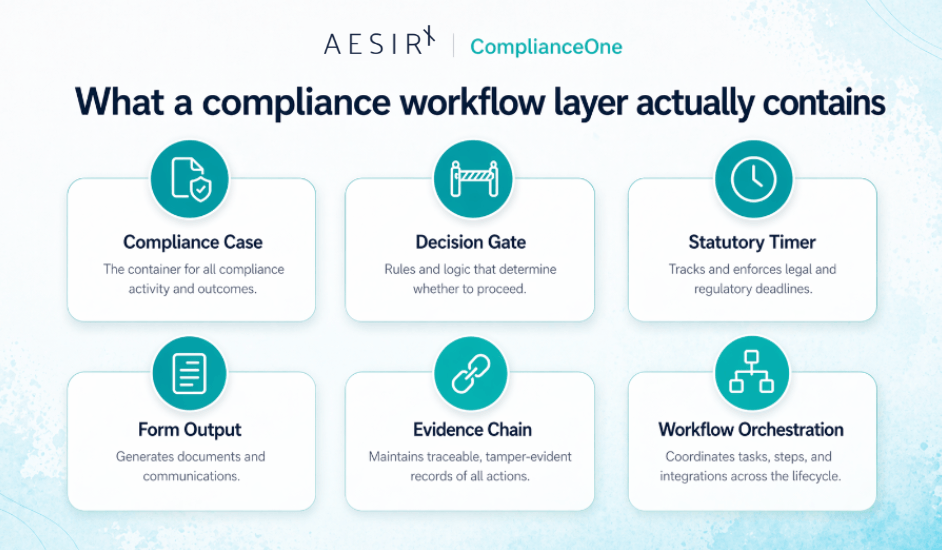
The compliance workflow layer that sits alongside security incident response is not a documentation exercise. It is a structured operational system with six specific elements, each operated alongside normal compliance work, with role-based access, a locked audit trail, and workflow controls – all implemented in the AesirX ComplianceOne platform today.
The incident case as a compliance object
The incident is represented in the platform as a case with a durable identity. The case has an owner, a status, a set of linked records, a defined approval chain, and an immutable audit trail. It is not the same object as the security ticket. It references the security ticket, ingests facts from it, and runs its own lifecycle. The case carries the notification decision, the affected data scope, the affected subject estimate, the legal basis assessment, the DPO sign-off, and the submission record. When the case closes, it closes because every compliance workflow it triggered has closed, not because the security threat has been contained.
The notification decision gate
A structured gate forces the DPO and legal counsel to make an explicit decision: notify, do not notify, or hold pending further facts. Each outcome captures a documented rationale. "Do not notify" is a legally defensible decision only when the rationale is recorded, the evidence supporting it is attached, and the DPO has signed off. The gate is not a formality. It is the artifact the regulator asks about when a decision is later challenged.
The statutory timer
The statutory notification window is tracked as a live timer in the platform, not as a calendar reminder. The timer starts when the case is opened. It escalates automatically at defined thresholds as the available window tightens, so assignment gaps, delayed legal review, and an unapproved notification package surface well before submission is at risk. The timer is visible to the DPO, the legal counsel, and the named executive. When the timer fires, the escalation is not missed.
The form output service
Mẫu số 08 is generated by the platform, not drafted by hand. The form is populated from the case record, carries the correct labels, and routes to the correct submission channel. The supplement response package, when the Ministry requests additional information, is generated as a linked artifact to the original filing, with lineage preserved and a handling-window timer attached.
The evidence capture layer
Every fact entered into the case is captured with a contributor, a timestamp, and a source. The audit trail is immutable. Attached documents are versioned. Approval signatures carry identity, role, and timestamp. Evidence is not reconstructed after the fact. It is locked at the moment each fact becomes part of the case.
The multi-workflow orchestration
When the case fires parallel workflows, the platform orchestrates them. The cross-border transfer reassessment opens against the vendor record linked in the case. The governance amendment opens against the processing activity linked in the case. The cybersecurity disclosure, where required, opens as its own filing case against the same incident record. Each workflow has its own owner, its own timer, and its own output. All of them share the incident evidence chain. None of them run twice.
Use case: the Saturday incident, now handled as a dual-track response
A retail bank's SOC flags the same Saturday anomaly described in the opening scenario. This time, the security alert simultaneously opens two cases in the platform: the security incident case in the SOC's own tooling, and the compliance case in the GRC platform. The compliance case is opened automatically by a connector that ingests the security alert and applies a rule: any alert involving a production system with known personal data exposure opens a compliance case with the statutory notification timer running.
The incident response lead is paged. The DPO is paged. The legal counsel is paged. All three receive a link to the same compliance case. The security team continues containment. The compliance case carries the parallel workflow.
By Saturday afternoon, the security team has confirmed the scope of accessed records. The facts are entered into the compliance case by the security lead as a structured contribution, captured with contributor identity, timestamp, and source. The DPO reviews the scope, confirms the incident meets the Article 23 notification threshold, and opens the notification decision gate. Legal counsel reviews the Mẫu số 08 draft generated by the platform, adjusts the language, and approves. The DPO signs. The notification is submitted to the specialized personal data protection authority on Sunday morning, well inside the statutory window.
Meanwhile, the platform has opened a parallel workflow against the vendor record, because the affected database sits behind a regional cloud provider with a cross-border transfer dossier on file. A reassessment task is assigned to the Vendor Governance Lead, who confirms that the transfer safeguards held, documents the conclusion, and closes the reassessment without a dossier-update filing under PDPL Article 22 / Decree 356 Articles 18 and 20. A third workflow checks the processing activity linked to the affected data scope and confirms no material change to registered processing occurred. When the authority responds with a supplement request later in the month, the supplement is handled by the same case, on its own handling-window timer, with all supporting evidence exportable from the case record.
The incident is not closed when the SOC marks the threat contained. It is closed when the notification is acknowledged, the data subject notification (if required) is delivered, the vendor reassessment is documented, the governance record is updated, and the audit trail is locked. All five closures are visible in the case. None of them depend on the DPO remembering to check.
How a vendor-caused incident creates cascading obligations
A multinational subsidiary in Vietnam uses a global SaaS analytics platform operated by its European parent company. The platform suffers a security incident. The parent company's incident response team contains the breach, notifies European regulators under GDPR, and sends a routine disclosure notice to the Vietnam subsidiary on day three of its own response.
In a traditional setup, the disclosure lands in a shared mailbox. It is forwarded to the local compliance lead. The local lead spends two days coordinating with the security team, the DPO, and legal counsel. By the time the notification decision is ready, the statutory window from the moment of detection is at risk, and the evidence chain looks reconstructed rather than captured.
In a platform-operated setup, the vendor disclosure is ingested as an incident event against the vendor record. The platform opens a compliance case with the statutory notification timer running from the moment of disclosure receipt. The vendor record provides the signed DPA, the cross-border transfer dossier, and the sub-processor list. The data-mapping inventory identifies the affected Vietnam processing activities. A reassessment task is opened against the cross-border transfer dossier under the PDPL Article 22 / Decree 356 Articles 18 and 20 update mechanics. The DPO reviews, decides that the notification threshold is met under PDPL Article 23, and routes Mẫu số 08 for approval. Legal counsel reviews, adjusts, and approves. The DPO signs. The notification is submitted to the specialized personal data protection authority on day one of the Vietnam-side clock.
The vendor incident was never the Vietnam security team's event. It was the Vietnam compliance function's event, carried through a workflow that did not require the security team to become a compliance operator.
How a defensible "do not notify" decision is recorded
A payments company experiences an incident in which a routine penetration test accidentally triggered an alert on a production system. The security team confirmed within an hour that no actual compromise occurred: the test script was misconfigured and touched a production endpoint in an unintended way, but no personal data was accessed. In a traditional setup, the incident is closed by the SOC, the test is retargeted, and the DPO is not consulted.
Three months later, an internal audit asks how the organization assessed the incident against the PDPL Article 23 notification obligation. The answer should be "we assessed it and concluded no notification was required, for the following documented reasons." The answer that exists is "the SOC closed the ticket."
In a platform-operated setup, even the false positive opens a compliance case with a notification decision gate. The DPO reviews the facts, confirms with the security lead that no personal data was accessed, documents the rationale, marks the decision as "do not notify," and signs. The case closes in under an hour. The audit trail shows the decision, the evidence, the signer, and the timestamp.
The audit question, when it eventually arrives, is answered in one export. The "do not notify" decision is not a gap. It is a recorded outcome of a defined workflow. This is the form of compliance discipline that carries an organization through regulator scrutiny, because the decisions that did not produce filings are as well evidenced as the decisions that did.
The shift: from security event to dual-track discipline
The organizations that run incident response as a pure security function are not wrong about the security work. They are wrong about where the obligation ends. Under PDPL and Decree 356, the compliance obligation starts the moment the security team becomes aware of the incident, runs on a statutory clock, and closes through a documented filing chain that the security team was never designed to produce.
The shift is not about asking the security team to do compliance work. It is about operating two tracks in parallel, each with its own discipline, each with its own tools, each with its own accountability. The security track contains the threat. The compliance track discharges the obligation. They share the incident facts. They diverge in output. They close on different criteria. When both tracks close cleanly, the incident is truly closed.
This dual-track model changes three things about how the function operates day to day. It changes the paging list: the DPO and legal counsel are paged alongside the incident response lead, not after them. It changes the case record: the compliance case is opened in parallel with the security ticket, not derived from it later. It changes the closure gate: the security incident cannot close the compliance case, and the compliance case cannot close without notification, reassessment, and audit trail lock.
“Containment is a security outcome. Notification is a legal outcome. Both must close for the incident to close. The platform is what keeps them moving on the same clock.”
The organizations that understand this quietly rebuild their incident response function as a dual-track discipline. The ones that do not discover, one regulator letter at a time, that their security program does not cover the obligations their DPO is accountable for. Those discoveries are expensive.
Closing
Incident response in a PDPL environment is a compliance workflow as much as a security event. The security team does work that no compliance platform can replicate. The compliance function does work that no security platform can discharge. The discipline is in running them together, on a shared incident record, with parallel decision gates, parallel timers, parallel filings, and a shared evidence chain that holds under regulator scrutiny.
A contained breach is a security success. A notified breach, with a documented decision chain, a generated Mẫu số 08, a confirmed submission, and a locked audit trail, is a compliance success. Both are required. The organizations that consistently achieve both are the ones that stopped treating incident response as a security-only function and built the compliance workflow layer beside it.
To see how the dual-track incident workflow operates in practice, visit AesirX ComplianceOne: https://aesirx.io/compliance-one
Request a demo to walk through a complete incident-to-filing lifecycle, from security alert ingestion through notification decision gate, Mẫu số 08 generation, Ministry of Public Security submission, supplement response, and vendor cross-border transfer reassessment, with the evidence chain captured at every step.
Ronni K. Gothard Christiansen
Technical Privacy Engineer & CEO @ AesirX.io
Laws referenced in this article:
- Vietnam Personal Data Protection Law 2025 (PDPL)
- Decree 356/2025/NĐ-CP on Cross-Border Data Transfers and Processor Governance
- Decree 13/2023/ND-CP on Personal Data Protection (legacy provisions where still applicable)
- Decree 53/2022/ND-CP on Cybersecurity Implementation
- Law on Cybersecurity 2018 and its successor provisions
- Administrative Procedures Decision 778/QĐ-BCA-A05 (Ministry of Public Security procedures)
Disclaimer: This article provides operational guidance based on publicly available regulatory texts. It does not constitute legal advice. Organizations should consult qualified legal counsel for jurisdiction-specific compliance requirements, especially where Ministry of Public Security breach notifications, data subject notification thresholds, cross-border transfer reassessment triggers, and cybersecurity incident disclosure obligations are involved.


