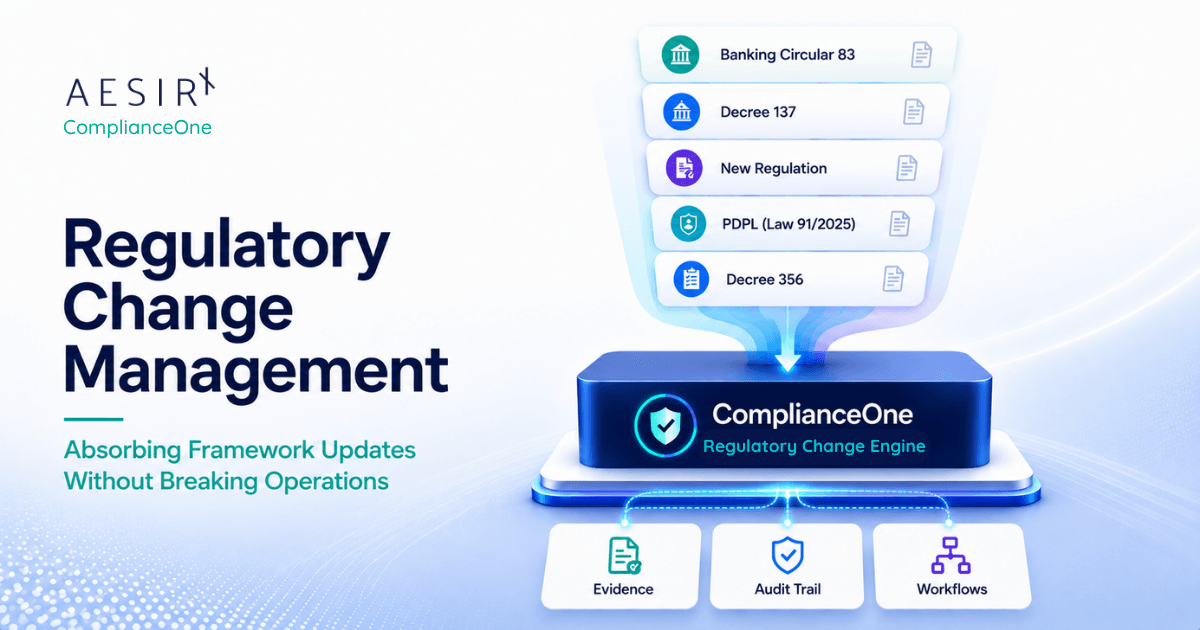
TL;DR: Regulatory frameworks in Vietnam and across Southeast Asia are evolving rapidly. From the baseline obligations of the Personal Data Protection Law (PDPL) and Decree 356 to specialized sector overlays like Banking Circular 83 and public-sector Decree 137, enterprise compliance teams face a continuous stream of new statutory requirements. Most organizations attempt to absorb regulatory updates through emergency manual audits, ad-hoc legal opinions, and massive policy re-writing projects. This reactive approach disrupts business operations, creates severe coverage gaps, and burns out compliance personnel. This article explains how leading enterprise organizations build an active regulatory change engine: decoupling core processing controls from fluid regulatory rules, mapping statutory obligations to modular technical controls, and maintaining continuous compliance across multi-framework environments without breaking daily business workflows.
A Vice President of Operations at a regional healthcare and financial conglomerate receives an urgent email from external legal counsel. A new sector circular governing data protection in financial services and electronic payments has just been issued, effective in 60 days. The circular introduces tighter encryption rules for transaction metadata, mandatory biometric verification logs, and shortened reporting windows for operational incidents.
The VP calls an emergency meeting with IT, legal, product, and risk leads. The immediate questions are daunting: Which of our existing 40 digital services are affected? What technical controls do we already have in place that satisfy these new requirements? How many vendor contracts must be amended? How long will it take to update our processing impact assessments and statutory filings?
For most enterprise organizations, a new regulatory update triggers a multi-month scramble. Teams halt product roadmaps, hire external consultants to perform manual gap assessments, and manually edit dozens of Word documents and spreadsheets. By the time the gap assessment is finished, another regulatory decree or industry guideline has already landed.
This reactive fire-fighting model is unsustainable.
Under Vietnam's evolving privacy and cybersecurity architecture, regulatory updates are not rare, isolated events. They are a permanent feature of the operating environment. The Personal Data Protection Law (Law No. 91/2025/QH15) sets the national baseline, Decree 356/2025/NĐ-CP establishes core procedural and filing mechanics, and sector-specific authorities regularly issue detailed technical circulars.
Organizations that succeed in this environment do not treat regulatory change as a crisis. They build a systematic regulatory change management capability that absorbs framework updates smoothly into daily operations.
“Regulatory change management is not about predicting every new law. It is about building an operational architecture that absorbs new rules without breaking existing systems.”
The High Cost of Reactive Compliance
The fundamental problem with traditional compliance management is that statutory obligations are hardcoded directly into static policies and manual procedures. When a law changes, every policy, form, and procedure must be manually unpicked, re-written, and re-approved.
This brittle coupling causes three major operational breakdowns.
1. The Coverage Blind Spot
When a new regulatory requirement is issued, compliance teams struggle to determine its precise operational impact. Does a new rule regarding cross-border transfer metadata affect your cloud analytics pipeline? Does a new retention rule for customer verification data apply to your mobile app logs?
Without a structured map connecting regulatory clauses to actual system components, organizations rely on guesswork. They risk over-engineering controls where they are not required, while leaving high-risk processing activities completely exposed to regulatory enforcement under PDPL Article 35.
2. Duplicate Control Inflation
When organizations handle multiple regulatory frameworks reactively, they create redundant controls for overlapping obligations.
For example, a commercial bank operating in Vietnam must comply with PDPL baseline privacy rules, Decree 356 filing mechanics, Banking Circular 83 security controls, and international standards such as ISO 27001 or PCI-DSS.
Without unified change management, separate teams build separate controls for each framework. Engineering implements three different log retention pipelines, legal drafts four different vendor addenda, and risk managers conduct five separate assessments for the same underlying data repository. This control inflation inflates operating costs and creates operational friction across engineering and business units.
3. The Re-Filing Paralysis
Under PDPL Article 22 and Decree 356 Article 20, changes in processing activities or legal obligations require updated statutory filings (Mẫu số 03a for processing impact updates or Mẫu số 03b for cross-border transfer updates).
When a regulatory update alters legal bases or technical safeguards across dozens of registered processing activities, manual compliance teams stall. The sheer volume of manual dossier updates overwhelms the team, leaving the organization operating under invalid statutory filings.
Architecting an Active Regulatory Change Engine
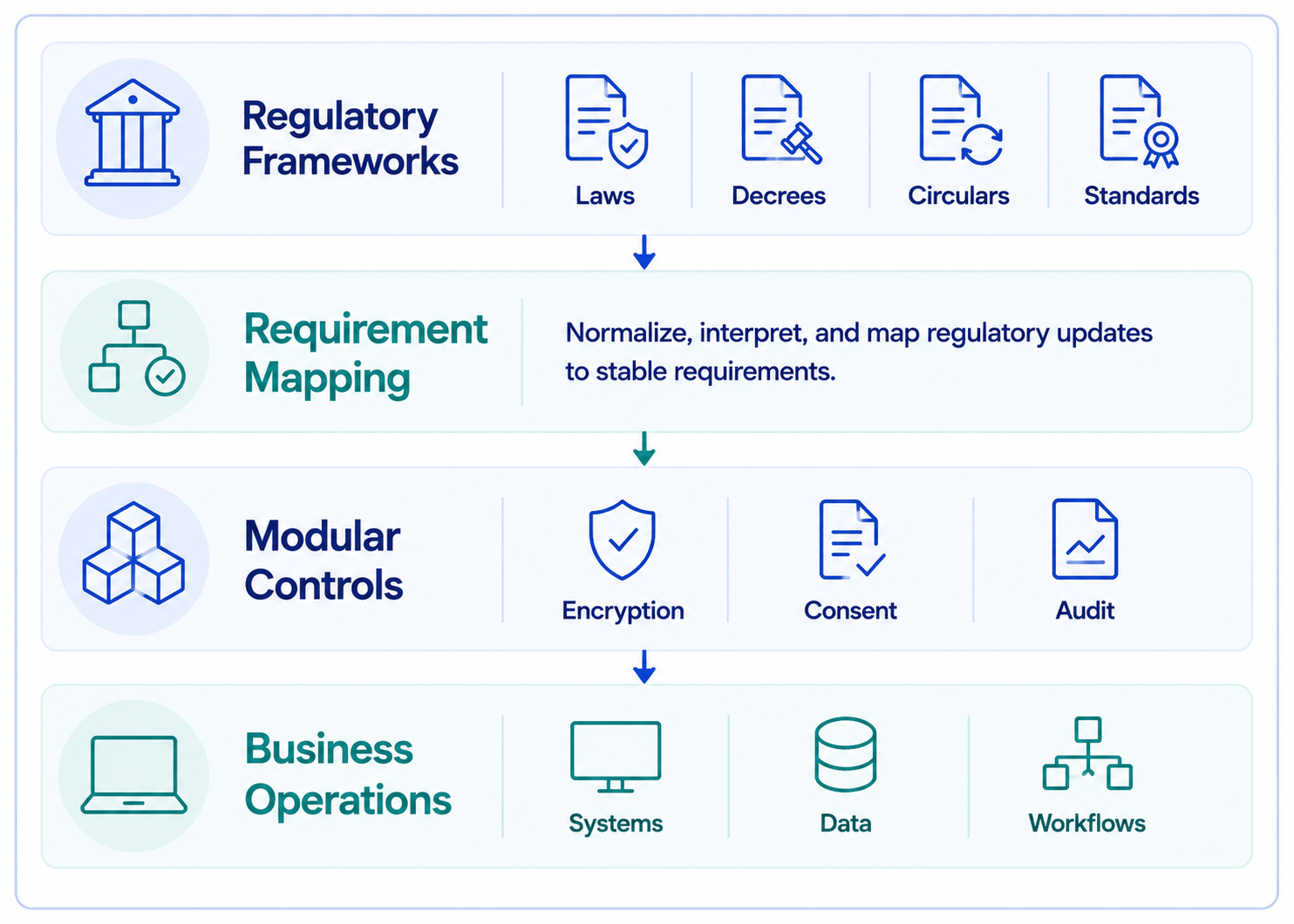
Absorbing regulatory change without operational disruption requires a fundamental architectural shift. Instead of tying business processes directly to specific legal clauses, enterprise platforms insert an abstraction layer: the regulatory change engine.
Decoupling Controls from Frameworks
The core principle of modern GRC architecture is the separation of statutory requirements from operational controls.
- Statutory Requirements: The fluid, external rules issued by regulators (e.g. PDPL Article 12 encryption rules, Banking Circular 83 transaction logging mandates, Decree 356 Article 19 DPIA triggers).
- Modular Technical Controls: The actual operational mechanisms implemented by your IT and business teams (e.g. AES-256 database encryption, centralized syslog ingestion, role-based access control, automated consent logging).
When a new law or circular is published, your engineering team should not need to rebuild security controls. Instead, compliance specialists map the new statutory requirement to your existing library of modular technical controls.
If an existing control already satisfies the new requirement, compliance is achieved instantly with zero engineering effort. If a control gap exists, engineering builds or configures a single modular control that satisfies the requirement across all applicable frameworks.
The Unified Control Framework (UCF) Mapping
By maintaining a unified control library, an organization can map a single operational action to multiple regulatory obligations simultaneously:
- A single encryption control satisfies PDPL Article 12, ISO 27001 A.10, and Banking Circular 83 data protection rules.
- A single consent logging workflow satisfies PDPL Article 9, Decree 356 Article 6, and ePrivacy consent requirements.
- A single vendor risk assessment satisfies Decree 356 Article 14 vendor oversight and ISO 27001 A.15 supplier relationship rules.
When a regulator updates a specific article, only the mapping rule changes. The underlying business workflow remains untouched.
“When you decouple technical controls from legal text, a regulatory update becomes a configuration change instead of an engineering overhaul.”
The 5 Pillars of Continuous Regulatory Adaptation
Establishing an enterprise regulatory change management discipline requires implementing five key capabilities across your GRC operations.
1. Automated Regulatory Feed Ingestion and Triage
Regulatory change management begins with awareness. Organizations must systematically monitor supervisory authority publications, legislative portals, and industry circulars.
An active GRC platform ingests new regulatory framework definitions, tagging individual statutory clauses with metadata:
- Applicable industry sectors (e.g. general enterprise, banking/finance, public sector, telecommunications).
- Target data categories (e.g. general personal data, sensitive health data, biometric identifiers, location data).
- Mandatory compliance deadlines and transitional rules under Decree 356 Article 41.
- Required filing instruments (e.g. Mẫu số 03a/03b updates, Mẫu số 08 incident reports).
This structured intake replaces informal email circulars with a centralized, triaged regulatory queue.
2. Automated Gap Analysis against Active Control Inventories
Once a new regulatory framework is ingested, the system automatically cross-references new statutory requirements against your organization's active control inventory.
Instead of spending weeks in manual discovery meetings:
- The engine evaluates existing verification evidence linked to mapped controls.
- It identifies fully satisfied requirements where existing evidence meets the new statutory threshold.
- It flags partial coverage gaps where existing controls require minor configuration adjustments.
- It highlights unmapped requirements that demand new operational procedures or technical controls.
This automated gap analysis delivers an instant, objective posture report to the DPO and CISO within hours of a regulatory release.
3. Impact Propagation and Asset Mapping
A single regulatory clause rarely applies uniformly across an entire enterprise. A requirement governing customer consent records (PDPL Article 9) affects web portals, mobile apps, customer service databases, and marketing automation tools.
An active change engine uses system dependency mapping to propagate regulatory impacts:
- Identifying all processing activities associated with the affected regulatory clauses.
- Mapping affected software applications, database repositories, and cloud environments.
- Highlighting external third-party processors and vendors handling the impacted data flows.
This impact propagation prevents hidden compliance gaps in secondary or legacy systems.
4. Dynamic Dossier Delta Generation
When a regulatory change requires updates to previously submitted statutory filings, manual re-drafting creates severe bottlenecks.
Under Decree 356 Article 20, changes in processing parameters or legal requirements mandate updated filings. An active submission engine calculates the precise delta between your last-submitted dossier (Mẫu số 01a/01b or Mẫu số 02a/02b) and the updated regulatory requirements:
- Automatically populating Mẫu số 03a (processing impact update) or Mẫu số 03b (transfer impact update) drafts.
- Highlighting only the specific fields, legal bases, or control descriptions that have changed.
- Preserving full historical versioning and audit trails across successive filings.
This targeted delta generation reduces update filing effort by up to 85%, ensuring that statutory filings remain synchronized with legal reality.
5. Continuous Evidence Re-Verification
Compliance is not proven by policy statements; it is proven by continuous technical evidence. When a regulatory framework updates a control standard (such as mandating stronger encryption or shorter log retention), existing evidence records must be re-verified.
The regulatory change engine automatically triggers evidence re-verification workflows:
- Requesting updated penetration test certificates or vulnerability scans.
- Re-validating third-party vendor security attestations against new statutory criteria.
- Routing updated control verification tasks to assigned system owners with strict completion deadlines.
Operational Walkthrough: Two Regulatory Adaptation Scenarios
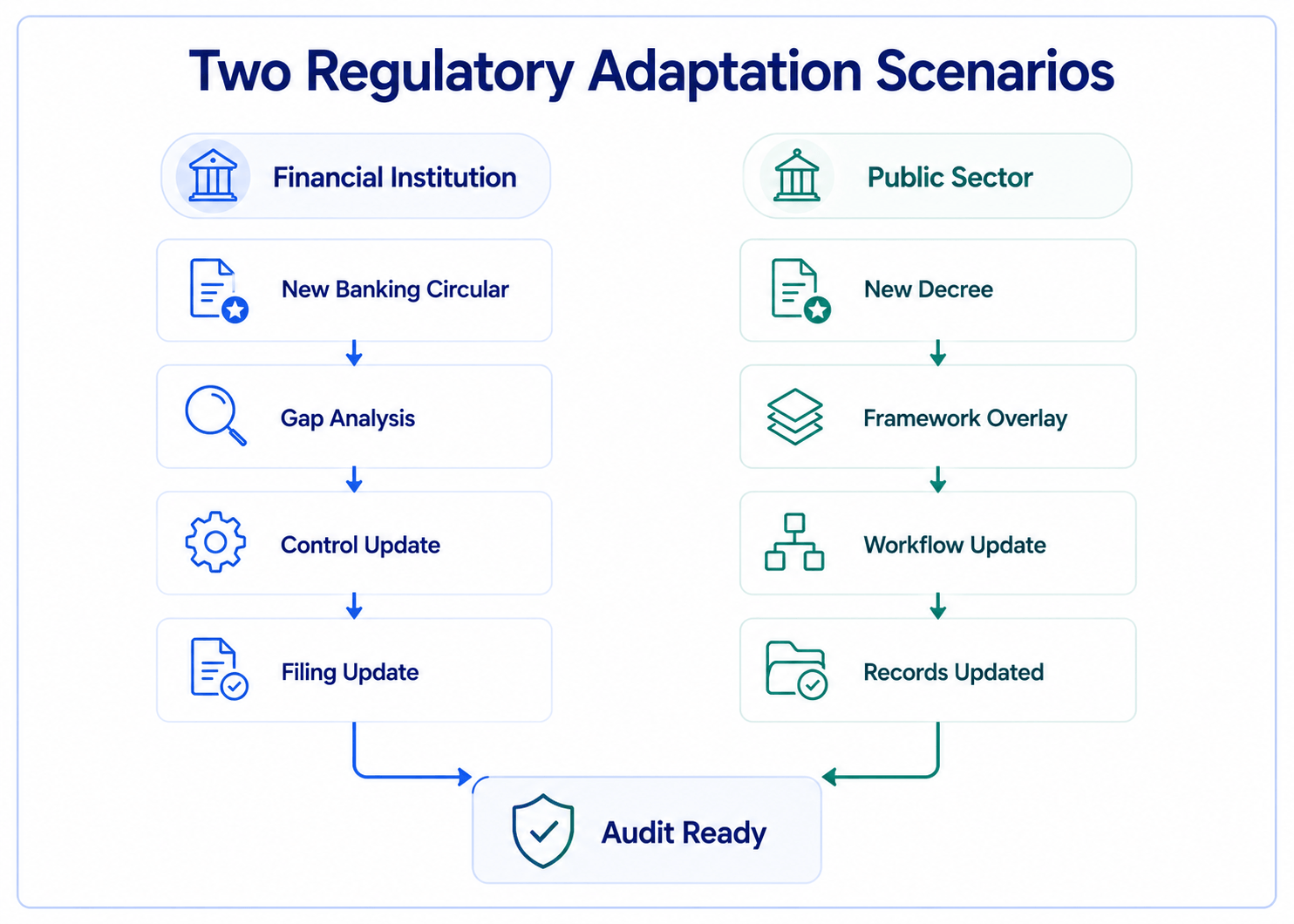
Let us examine how an active change management engine operates in two real-world enterprise scenarios.
Scenario A: Financial Institution Absorbing a Sector Regulatory Circular
A commercial bank operating in Vietnam must adapt to a new regulatory circular from financial supervisors that tightens data protection rules for online banking transactions and third-party payment gateways.
- Ingestion & Triage: The compliance team ingests the new circular into the platform. The change engine extracts 18 specific statutory requirements across encryption, consent logging, vendor risk, and incident notification.
- Automated Gap Analysis: The engine evaluates the bank's active control inventory. It determines that 12 requirements are already fully satisfied by existing ISO 27001 and PDPL baseline controls. 4 requirements require minor policy mapping updates, and 2 requirements (specific transaction log retention and enhanced vendor audits) represent genuine control gaps.
- Targeted Action Routing: The platform automatically generates remediation tasks: routing the logging configuration task to infrastructure engineers and the vendor audit update to procurement leads.
- Statutory Filing Update: Because the circular alters processing parameters for online payments, the system pre-populates an updated Mẫu số 03a processing impact dossier under Decree 356 Article 20.
- Audit Readiness: Within 14 days of publication, the bank achieves 100% verified compliance, with a complete audit trail showing gap identification, control remediation, and updated statutory filings.
Scenario B: Public Sector Enterprise Adapting to Decree 137 Data Sharing Rules
A state-owned utility corporation managing citizen service data must comply with new public-sector data governance and sharing rules under Decree 137/2024 alongside baseline PDPL requirements.
- Framework Overlay: The organization applies the Decree 137 public-sector framework overlay on top of its existing PDPL processing baseline.
- Conflict Identification: The change engine cross-references Decree 137 data classification rules against existing PDPL categories, identifying specific municipal data flows that require elevated authorization before external transfer.
- Workflow Enforcement: The system automatically updates in-app authorization workflows, enforcing dual-approver sign-offs for affected data transfer requests without altering underlying database architectures.
- Dossier Alignment: The platform updates the organization's Records of Processing (ROPA) and cross-border transfer assessments (Mẫu số 09), ensuring that all statutory documentation reflects the combined PDPL and Decree 137 requirements.
The Paradigm Shift: Moving from Compliance Crisis to Operational Resilience
When enterprise organizations replace reactive fire-fighting with an active regulatory change engine, compliance transforms from an unpredictable operational risk into a manageable business process.
Product managers build new features with confidence, knowing that modular controls automatically align with current laws. Data Protection Officers present clear, real-time posture dashboards to board members and supervisory inspectors under PDPL Article 35. Executive leadership expands into new markets and business lines knowing that the organization can absorb new regulatory frameworks without breaking daily operations.
Regulatory change is inevitable. Operational disruption is optional.
Summary and Key Takeaways
- Hardcoding statutory clauses into static policies creates brittle compliance that breaks whenever laws or circulars are updated.
- Modern GRC architecture decouples fluid regulatory requirements from modular technical controls, allowing new rules to map to existing operational controls.
- Unified Control Frameworks eliminate duplicate control inflation by enabling a single technical control to satisfy multiple regulatory standards simultaneously.
- Automated gap analysis and impact propagation allow DPOs to assess the exact operational impact of a new law within hours of publication.
- Dynamic delta generation pre-populates Mẫu số 03a/03b update filings under Decree 356 Article 20, maintaining continuous statutory alignment without manual re-drafting.
Explore how your organization can automate regulatory change management and maintain continuous multi-framework compliance: https://aesirx.io/compliance-one
Ronni K. Gothard Christiansen
Technical Privacy Engineer and CEO, AesirX.io
Laws and standards referenced
- Vietnam: Law on Personal Data Protection (PDPL), Articles 5, 12, 20, 21, 22, 34, 35, and 37.
- Vietnam: Decree 356/2025 (Decree 356), Articles 6, 18, 19, 20, 28, 31, and 41 (Forms Mẫu số 01a/01b, 02a/02b, 03a/03b, 08, 09, 10).
- Vietnam: Banking Circular 83/2025 (sector overlay) and Decree 137/2024 (public sector data management).
- International: ISO/IEC 27001:2022 controls and GDPR Article 35 (DPIA and ongoing review).
Disclaimer
This article is operational guidance from a platform vendor, not legal advice. Specific regulatory change management procedures and statutory update requirements under Vietnam's PDPL, Decree 356, and sector circulars should be confirmed with qualified Vietnamese legal counsel for your specific industry sector and supervisory authority.


