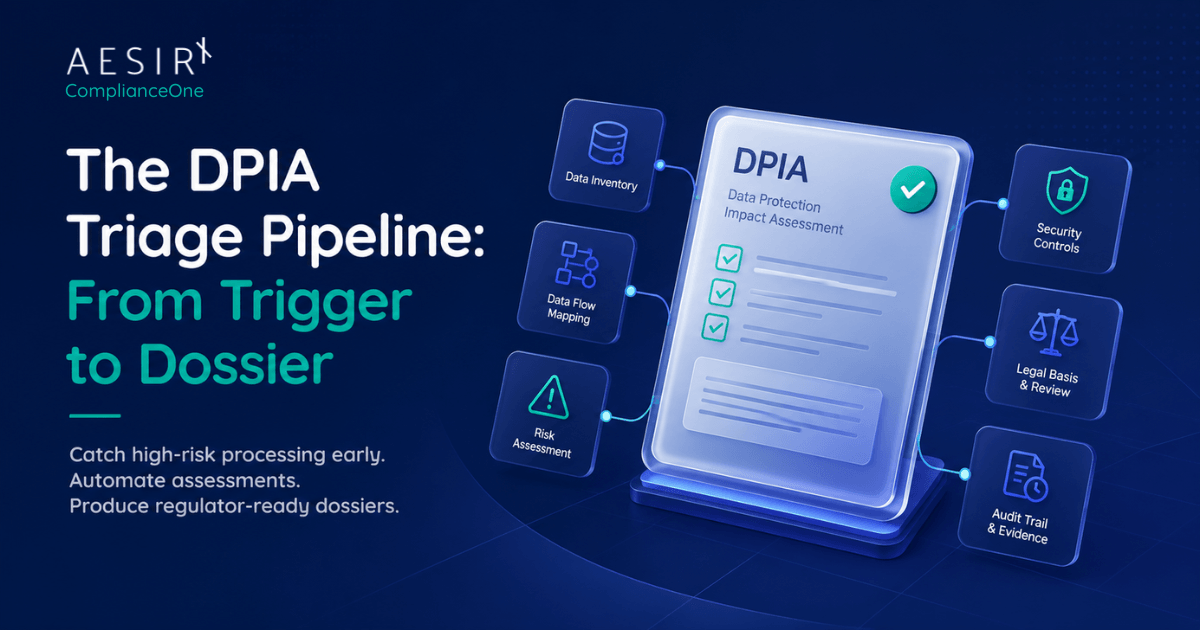
TL;DR: Conducting a Data Protection Impact Assessment (DPIA) under Vietnam's Personal Data Protection Law (PDPL Article 21) and Decree 356/2025/NĐ-CP (Article 19) is often viewed as a bureaucratic speedbump that delays product launches. Product and engineering teams dread the lengthy Word documents, manual risk scoring spreadsheets, and multi-week back-and-forth reviews with legal counsel. Meanwhile, Data Protection Officers (DPOs) struggle to identify high-risk data processing activities before software goes live. This article explains how leading enterprise organizations replace manual DPIA paperwork with an automated DPIA triage pipeline: catching processing triggers in Jira and GitHub, auto-populating statutory risk parameters from active data inventories, executing multi-party sign-offs, and assembling regulator-ready Mẫu số 02a/02b dossiers backed by Mẫu số 10 assessment reports as an operational byproduct of software delivery.
A lead software architect for a retail banking app submits a pull request for a new biometric authentication feature. The feature collects facial geometry vectors to verify high-value fund transfers. The code is scheduled for production deployment in two weeks.
Three days before launch, the internal risk team discovers that no processing impact assessment has been completed. The deployment is halted immediately. Engineers scramble to answer a 60-question word processor template. Product managers guess at data storage locations, legal counsel drafts consent disclosures in a rush, and the DPO attempts to evaluate technical safeguards without architectural diagrams.
The product launch is delayed by a month. The engineering team resents the compliance process, and the resulting paper DPIA is archived in a shared folder, never to be opened again until an auditor asks for it under PDPL Article 35.
This friction is universal across enterprise organizations.
Under Vietnam's privacy framework, a DPIA is not an optional best practice. PDPL Article 21 mandates that data controllers and processors perform a formal assessment of personal data processing impacts prior to launching high-risk processing activities. Decree 356 Article 19 details the mandatory dossier components (Mẫu số 02a for controllers or Mẫu số 02b for joint controllers/processors), supported by a comprehensive Mẫu số 10 assessment report.
When organizations manage DPIAs as isolated documentation projects, compliance becomes a bottleneck to business growth.
Organizations that scale privacy operations smoothly do not run DPIAs as separate projects. They embed an automated DPIA triage pipeline directly into daily business and engineering workflows.
“A DPIA should not be a documentation project that halts innovation. It should be an operational pipeline that captures risk proof as code moves to production.”
The Failure of Manual Impact Assessments
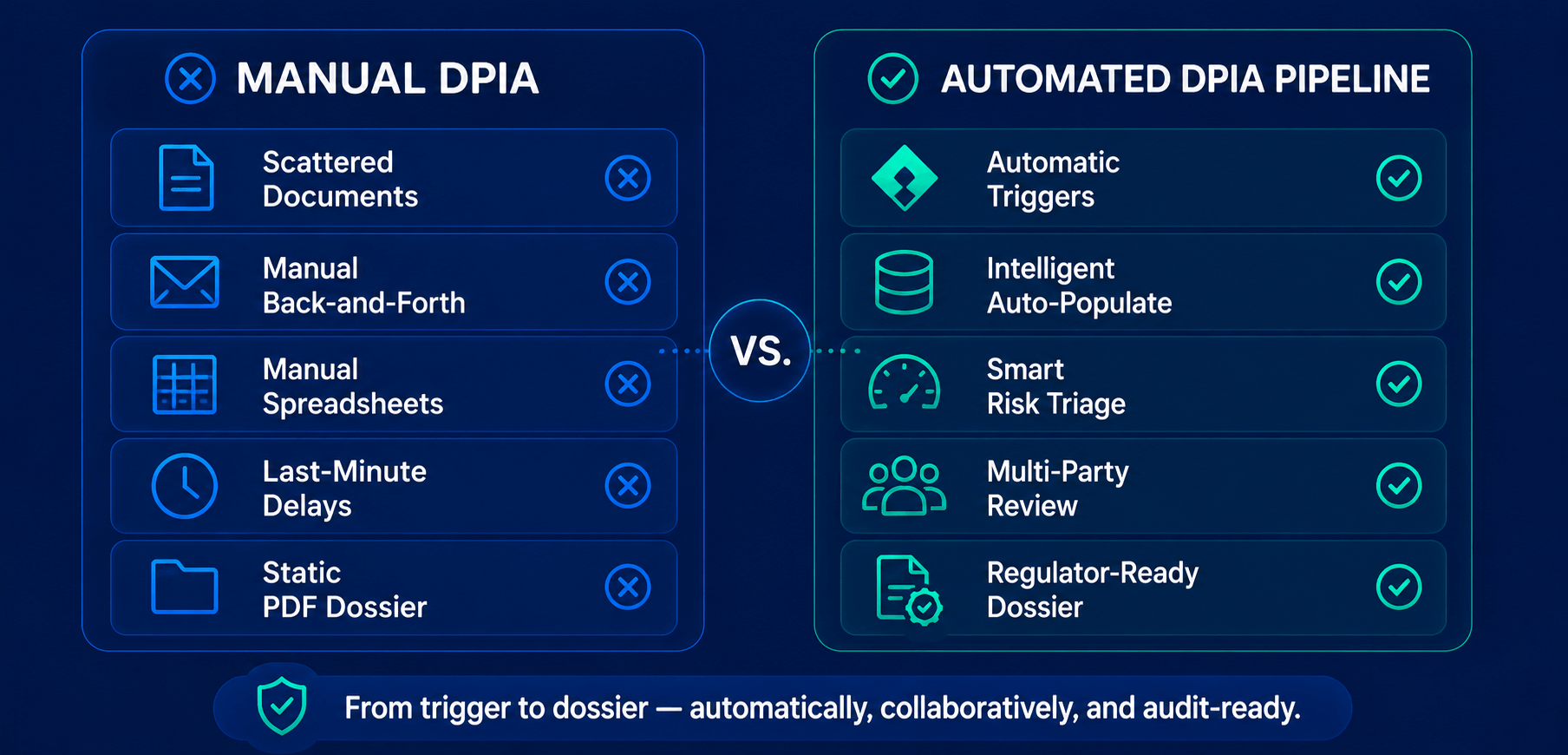
The traditional approach to DPIAs suffers from structural flaws that undermine both speed and regulatory compliance.
1. The Late-Stage Discovery Trap
In manual environments, compliance teams learn about new processing activities at the very end of the development lifecycle, during pre-launch security reviews or procurement sign-offs.
By this stage, system architecture is locked, database schemas are finalized, and commercial launch dates are set. Discovering a major privacy risk late in the cycle forces organizations to choose between two unacceptable options: delay the launch for weeks of re-engineering, or launch with unmitigated regulatory liability under PDPL Article 37.
2. The Questionnaire Burden and Fatigue
Traditional DPIAs rely on static, 50-page questionnaire templates filled out by product managers or engineers.
Because engineers are not privacy lawyers, they struggle with abstract legal questions ("Is the processing necessary and proportionate under PDPL Article 3?"). They provide generic, vague answers ("We store data securely in the cloud"). Compliance officers then spend weeks interviewing engineers to translate technical reality into statutory terminology. This back-and-forth drains engineering capacity and creates massive compliance friction.
3. The Abandoned Dossier Problem
A static Word document or PDF represents a single snapshot of a system at launch. Over the following months, software teams update API endpoints, add third-party analytics SDKs, and expand data retention windows.
Under PDPL Article 22 and Decree 356 Article 20, any material change to processing activities requires an updated DPIA dossier (Mẫu số 03a). Because updating a manual Word document is painful, organizations ignore small updates. Within six months, the filed DPIA dossier is completely decoupled from operational reality.
Architecting the Automated DPIA Triage Pipeline
Transforming DPIA from a manual burden into an automated pipeline requires connecting product management tools, data classification registers, and statutory form generation engines.
Stage 1: Automated Operational Triggers
DPIAs should not rely on human memory or manual emails. The pipeline begins with automated triggers embedded in existing operational tools:
- Jira / Linear Epics: Creating a new product feature tagged with "sensitive data", "third-party sharing", or "automated decision-making" automatically triggers a lightweight GRC intake workflow.
- CI/CD Code Scanning: Adding new database models, API routes, or external SDK dependencies in software code repositories automatically notifies the GRC engine.
- Procurement Workflows: Onboarding a new cloud vendor or data processor automatically initiates a vendor-linked DPIA triage request.
These triggers ensure that 100% of high-risk processing activities are captured at the design phase, months before production launch.
Stage 2: Intelligent Risk Triage and Threshold Scoring
Not every software update requires a 40-page statutory Mẫu số 10 assessment report. Minor bug fixes or UI updates should bypass full DPIA review entirely.
The triage engine evaluates intake parameters against statutory risk thresholds under Decree 356 Article 19:
- Low-Risk Processing: Standard internal operations using non-sensitive data are auto-cleared with an automated log entry.
- Medium-Risk Processing: Routine processing involving personal data triggers a streamlined 5-minute technical verification questionnaire.
- High-Risk Processing: Activities involving sensitive data (health, biometric, financial location data under Decree 356 Article 4), large-scale data subjects, or automated profiling automatically initiate a full statutory DPIA workflow.
This intelligent triage eliminates 70% of unnecessary assessment overhead, allowing compliance teams to focus 100% of their energy on high-risk processing.
“Intelligent triage separates routine code updates from high-risk processing, eliminating 70% of compliance noise.”
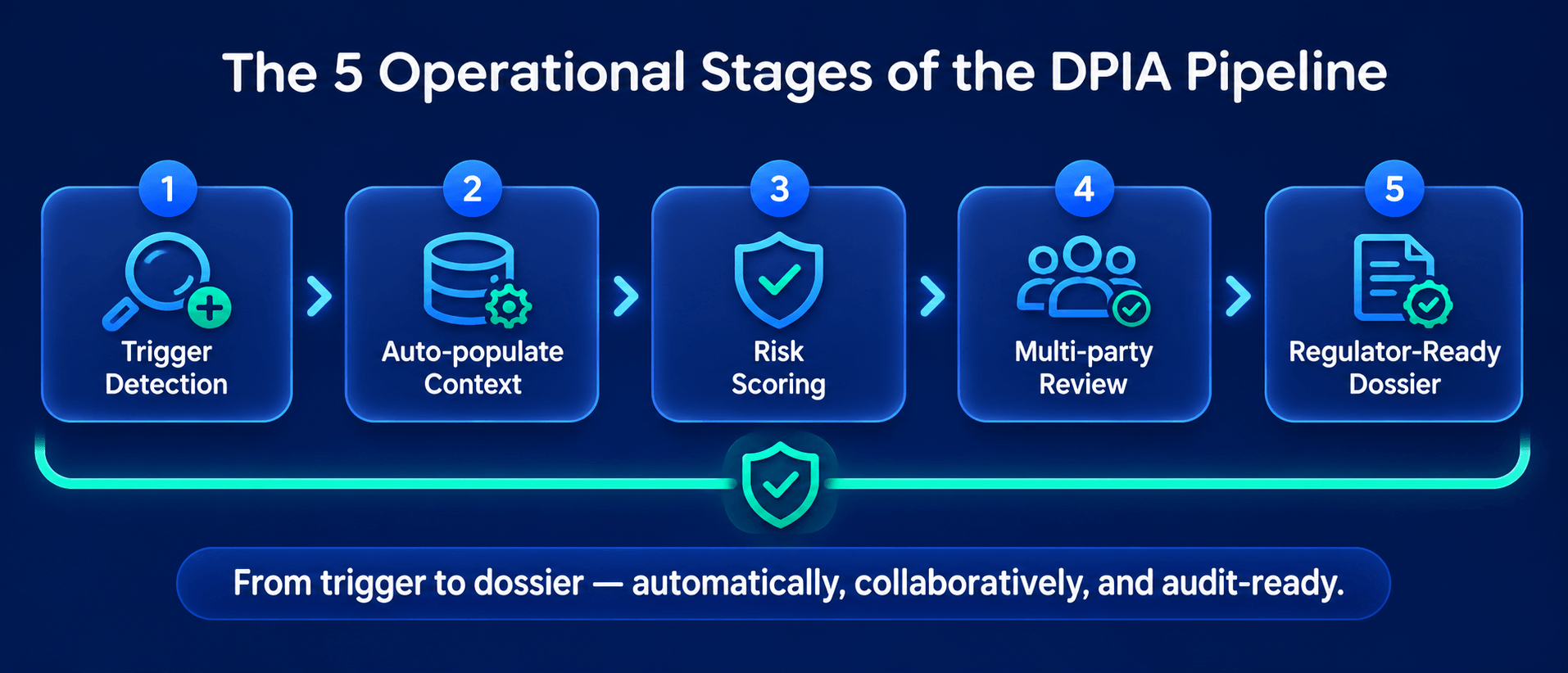
The 5 Stages of an Automated DPIA Pipeline
Building an enterprise DPIA triage engine requires establishing five operational stages across your product, engineering, and legal workflows.
1. Data-Bound Auto-Population
Instead of forcing engineers to type manual descriptions of database fields, the DPIA engine binds directly to your central system inventory and data classification registers.
When a product team initiates a DPIA for a new feature:
- Personal data categories (e.g. customer name, national ID, phone number, biometric vectors) auto-populate from database schemas.
- Legal bases map automatically from verified consent mechanisms under PDPL Article 9 or statutory exemptions under PDPL Article 19.
- Technical protection measures (AES-256 encryption at rest, TLS 1.3 in transit) pull directly from verified infrastructure configurations under PDPL Article 12.
This auto-population reduces form-filling time from days to minutes while ensuring 100% technical accuracy.
2. Automated Necessity and Proportionality Scoring
PDPL Article 21 and Decree 356 Article 19 require organizations to demonstrate that data processing is necessary and proportionate to the declared business purpose.
The DPIA engine calculates automated necessity and proportionality scores based on structured parameters:
- Data Minimization Check: Flagging if sensitive data categories are requested without a direct functional requirement.
- Purpose Limitation Check: Verifying that declared processing purposes match consent disclosures.
- Storage Limitation Check: Confirming that data retention schedules bind to operational deletion workflows under PDPL Article 14.
If an over-broad data request is detected, the platform alerts the project team during design, allowing them to adjust data requests before code is written.
3. Collaborative, Role-Gated Review Workflows
A statutory DPIA requires multi-disciplinary evaluation. Rather than passing a single Word document around via email, the DPIA pipeline enforces structured multi-party review in a shared digital workspace:
- Engineering Lead: Verifies technical architecture, data flows, and security controls.
- Cybersecurity Lead: Evaluates threat vectors, encryption key management, and access controls.
- Legal Counsel: Confirms legal basis validity, contractual safeguards, and regulatory risk ratings.
- Data Protection Officer: Performs final evaluation of residual risk, signing off on proportionality and necessity.
Each review step is timestamped, locked, and appended to the immutable audit trail.
4. Statutory Package Assembly (Mẫu số 02a/02b and Mẫu số 10)
Once all internal approvals are complete, the DPIA engine automatically compiles the official statutory submission package required by the Ministry of Public Security under Decree 356 Article 19:
- Primary Submission Form: Generating Mẫu số 02a (for data controllers) or Mẫu số 02b (for joint controllers/processors) as the formal cover instrument.
- Comprehensive Assessment Report: Generating the detailed Mẫu số 10 assessment report, complete with risk matrices, mitigation measures, and DPO conclusions.
- Supporting Evidence Index: Attaching system architecture diagrams, encryption verification logs, and third-party processing agreements.
- Cryptographic Hashing: Stamping the entire package with a SHA-256 digest to prove integrity prior to filing.
5. Continuous Delta Monitoring and Automated Re-Filing Triggers
A DPIA is not finished when the dossier is filed. It enters active monitoring mode.
The GRC platform continuously monitors active software deployments and system inventories against the filed DPIA baseline:
- If a new data category is added to the processing activity, the system flags a posture drift.
- If a new sub-processor is added, the engine highlights the change.
- The system automatically pre-populates an updated Mẫu số 03a dossier under Decree 356 Article 20, allowing the DPO to submit a targeted amendment to the regulator in minutes.
Operational Walkthrough: Two DPIA Pipeline Scenarios
Let us examine how an automated DPIA triage pipeline functions in two real-world enterprise scenarios.
Scenario A: Launching a Mobile App Facial Recognition Feature
A digital retail platform plans to introduce facial recognition login for high-value customer accounts. Because facial geometry is sensitive biometric data under Decree 356 Article 4, this feature requires a mandatory DPIA under PDPL Article 21 and Decree 356 Article 19.
- Trigger: The mobile product lead creates a epic in Jira titled "Biometric Login Integration". The GRC plugin detects the "biometric" tag and automatically initiates a DPIA triage workflow.
- Triage & Auto-Population: The triage engine classifies the feature as High Risk. System schema links auto-populate biometric vector data types, local device storage parameters, and cloud matching endpoints into the Mẫu số 10 draft.
- Automated Risk Mitigation: The engine flags that raw facial images should not be transmitted to cloud servers. Engineering updates the architecture to extract and encrypt mathematical vectors locally on the device.
- Multi-Party Sign-Off: Cybersecurity signs off on AES-256 vector encryption, legal approves the biometric consent modal text under PDPL Article 9, and the DPO approves the final risk rating.
- Statutory Dossier Assembly: The engine generates the official Mẫu số 02a submission form and backing Mẫu số 10 report, complete with technical encryption evidence.
- Outcome: The DPIA filing is completed two weeks before launch, establishing complete regulatory compliance without delaying product release.
Scenario B: Updating a Cloud Logistics Analytics Engine
A logistics company updates its internal route optimization engine, adding real-time driver GPS location tracking (sensitive location data under Decree 356 Article 4).
- Code Level Detection: A pull request in GitHub adding GPS location ingestion APIs triggers the GRC code-scanning pipeline.
- Delta Detection: The system compares the new location data ingestion against the last-filed DPIA dossier for logistics operations. It detects a material change under Decree 356 Article 20.
- Pre-Populated Update: Instead of initiating a full 40-page assessment, the platform generates a targeted Mẫu số 03a processing impact update form highlighting only the newly added location data category and updated retention rules.
- Rapid Review: Legal counsel and the DPO review the pre-populated Mẫu số 03a delta in 15 minutes and authorize submission to the regulator.
- Outcome: The organization maintains 100% continuous statutory compliance with zero manual paperwork overhead.
DPIA as a Competitive Advantage
When enterprise organizations transition from manual DPIA paperwork to an automated triage pipeline, privacy compliance ceases to be a product bottleneck.
Product teams innovate rapidly, knowing that privacy guardrails are built directly into their development tools. DPOs gain complete visibility into processing risks across the entire digital estate, presenting verified posture reports to supervisory authorities under PDPL Article 35. Executive leadership moves quickly into new digital markets, confident that every processing activity is backed by regulator-ready Mẫu số 02a/02b and Mẫu số 10 dossiers.
A paper DPIA is a snapshot that dates instantly. A DPIA triage pipeline is a living engine of trust.
Summary and Key Takeaways
- Manual DPIAs conducted at the end of software development cycles delay product launches and produce obsolete paper dossiers.
- Automated operational triggers in Jira, GitHub, and procurement tools catch high-risk processing activities at the design phase.
- Intelligent triage separates routine code updates from high-risk processing, eliminating 70% of assessment noise.
- Auto-populating form fields from active system inventories reduces form-filling time from days to minutes while guaranteeing technical accuracy.
- Continuous delta monitoring tracks changes against filed baselines, pre-populating targeted Mẫu số 03a update dossiers under Decree 356 Article 20.
Explore how your organization can automate DPIA triage and maintain continuous statutory compliance: https://aesirx.io/compliance-one
Ronni K. Gothard Christiansen
Technical Privacy Engineer and CEO, AesirX.io
Laws and standards referenced
- Vietnam: Law on Personal Data Protection (PDPL), Articles 3, 4, 9, 12, 14, 19, 21, 22, 35, and 37.
- Vietnam: Decree 356/2025 (Decree 356), Articles 4, 19, and 20 (Forms Mẫu số 02a/02b, 03a, 10).
- International: GDPR Article 35 (Data Protection Impact Assessment) and ISO/IEC 27701 (Privacy Information Management).
Disclaimer
This article is operational guidance from a platform vendor, not legal advice. Specific DPIA procedures and statutory dossier requirements under Vietnam's PDPL and Decree 356 should be confirmed with qualified Vietnamese legal counsel for your specific industry sector and supervisory authority.


