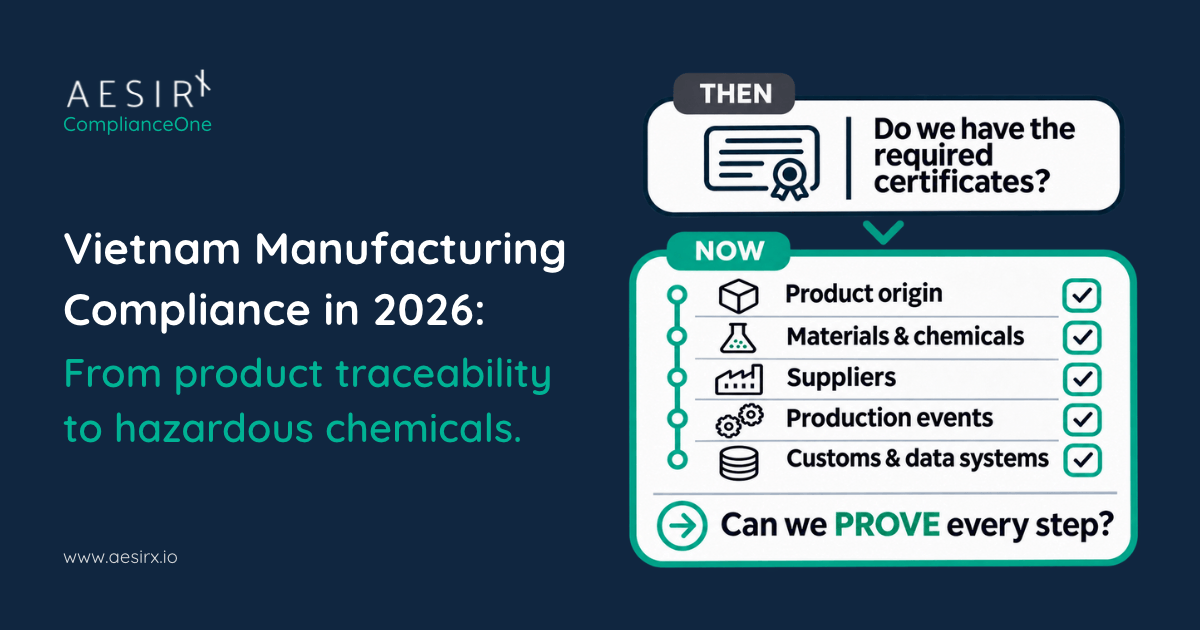
TL;DR: Vietnam’s manufacturing regulatory environment changed significantly during 2026. For manufacturers, importers and supply-chain companies, compliance is increasingly moving beyond certificates and periodic inspections toward continuous evidence about products, materials, suppliers, production events, environmental responsibilities and digital systems.
For many international manufacturers operating in Vietnam, the challenge is not one new law.
A single product may now sit within an interconnected regulatory environment covering product quality, risk classification, traceability, technical regulations, chemicals, environmental responsibility, customs, cybersecurity and data governance.
That is particularly relevant to Nordic companies operating factories in Vietnam, sourcing from Vietnamese manufacturers, importing products into the country, or using Vietnam as part of a regional supply chain.
The practical question is therefore changing from:
“Do we have the required certificates?”
to:
“Can we demonstrate where this product came from, which materials went into it, which regulatory requirements apply, what happened throughout its lifecycle, and what evidence supports each step?”
Several important regulatory developments are driving that change.
| Regulatory area | Key instruments | Operational impact |
| Product quality | Law on Product and Goods Quality, amended by Law 78/2025/QH15; Decree 37/2026/NĐ-CP; Circulars 33 and 34/2026/TT-BCT | Risk classification, conformity and quality-management evidence |
| Product traceability | Circular 31/2026/TT-BCT; Decree 372/2026/NĐ-CP | Digital product identification and supply-chain traceability |
| Chemicals | Chemicals Law 69/2025/QH15; Decree 26/2026/NĐ-CP | Chemical activities and hazardous chemicals in products and goods |
| Specially controlled chemicals | Circular 154/2026/TT-BCA | Digital identification and traceability across the chemical supply chain |
| Technical regulations | Amended standards and technical-regulations framework; Circular 37/2026/TT-BCT and applicable QCVNs | Product-specific limits, testing and conformity evidence |
| Environmental responsibility | Environmental Protection Law 72/2020/QH14; Decree 110/2026/NĐ-CP | Extended Producer Responsibility for products and packaging |
| Connected manufacturing | Data Law, Personal Data Protection Law, Cybersecurity Law and implementing instruments | Governance of factory systems, OT/IIoT, logs, vendors and operational data |
The exact requirements depend on the manufacturer's products, activities and role in the supply chain. But the direction is clear:
Vietnam is creating a more connected regulatory evidence environment around manufactured products.
Product Quality Is Becoming Risk-Based
Vietnam's Law on Product and Goods Quality has been substantially updated through Law 78/2025/QH15, effective from 1 January 2026, with Decree 37/2026/NĐ-CP providing detailed implementation measures.
For manufacturers, one of the important changes is the growing use of risk-based product classification.
Circular 33/2026/TT-BCT, effective from 1 July 2026, establishes lists of medium-risk and high-risk products and goods under the responsibility of the Ministry of Industry and Trade. The lists connect products with HS codes, applicable national technical regulations and corresponding quality-management requirements.
This matters because compliance can no longer be approached simply by asking whether a factory has a generic quality-management programme.
The relevant questions become more specific:
What exactly is beingmanufactured or imported? How is it classified? Which HS code applies? Is the product considered medium or high risk? Which technical regulation applies? What conformity-assessment evidence is required? Has that evidence been maintained for the relevant product and production period?
Circular 33 covers, among other areas, chemicals and chemical-containing products, industrial equipment, machinery and other goods within the Ministry's regulatory responsibility.
At the same time, Circular 34/2026/TT-BCT establishes the Ministry of Industry and Trade's product and goods quality-management framework for manufacturers, traders, importers, exporters and relevant conformity-assessment organisations.
For manufacturers, this pushes compliance toward a structured relationship between:
product → classification → applicable requirement → testing or conformity evidence → responsible owner → supporting records.
That relationship needs to remain visible as products, suppliers, materials and technical regulations change.
Product Traceability Is Becoming Digital Infrastructure
Perhaps the most important operational development for manufacturers is Vietnam's move toward more formalised digital product traceability.
Circular 31/2026/TT-BCT, effective from 1 July 2026, regulates traceability for high-risk products and goods under the Ministry of Industry and Trade.
For products within scope, manufacturers, traders and importers can use the Ministry's VeriGoods traceability system or operate an internal traceability system connected with it.
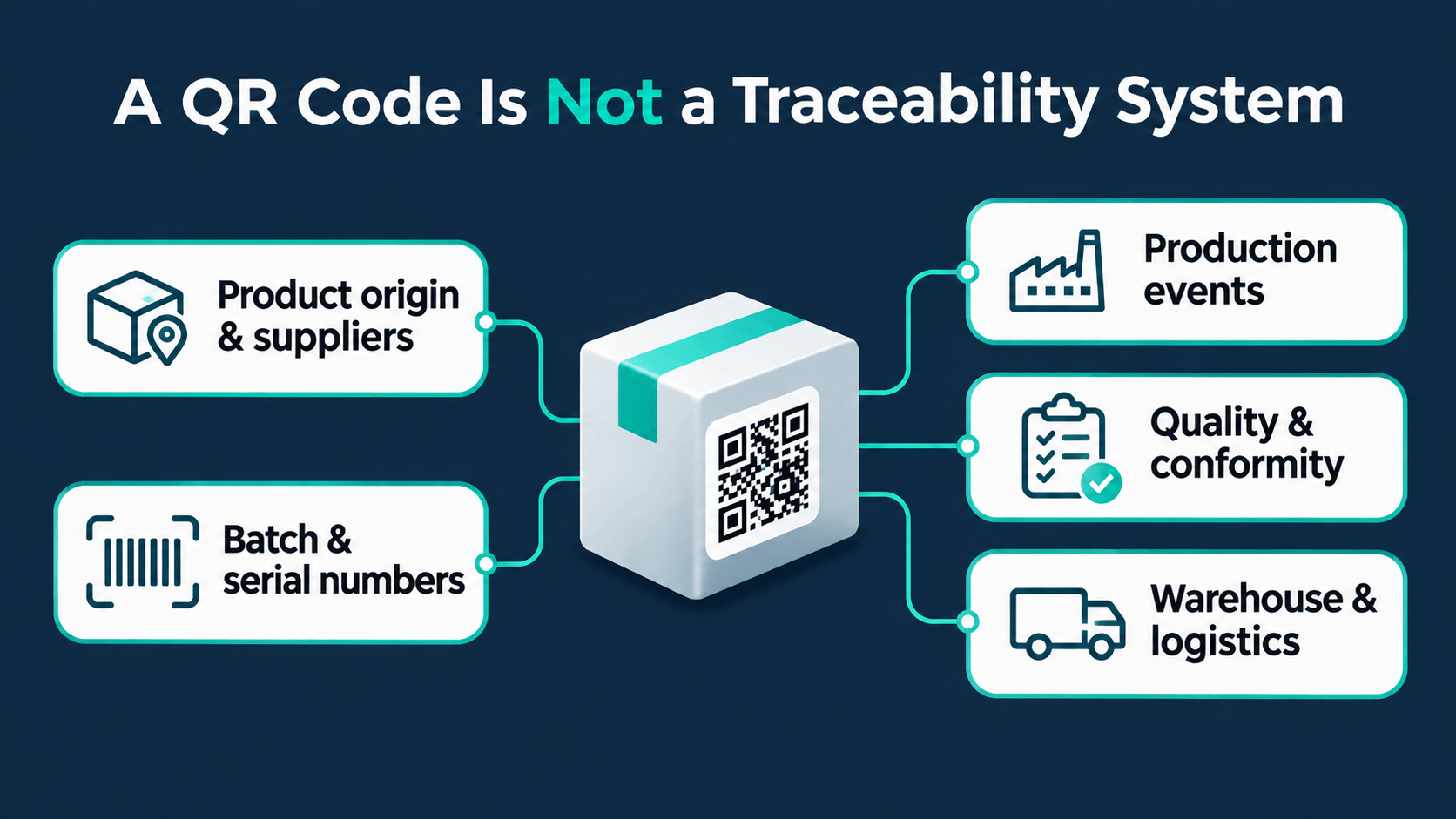
The underlying data goes considerably beyond placing a QR code on packaging.
Traceability information can include product origin, manufacturer and trader information, traceability codes, batch or serial numbers, expiry information where applicable, standards and technical regulations, and important tracking events throughout the supply chain. Circular 31 refers specifically to critical tracking events and standards such as Vietnam's TCVN 12850 or the GS1 Global Traceability Standard.
That means traceability becomes a data-governance process.
A manufacturer needs confidence not only that a product can be scanned, but that the underlying information is accurate and can be connected back to production, supplier, quality and logistics records.
Decree 372 takes this further
On 29 September 2026, the Government issued Decree 372/2026/NĐ-CP on product and goods identification, authentication and traceability, effective 1 January 2027.
The decree establishes a national architecture around product identification and traceability, including unique product identifiers, product master data, supply-chain information and integration with the national platform for product identification, authentication and traceability.
The framework supports identification down to product unit, batch, lot or product type depending on the applicable requirements, and is designed to connect data rather than force companies to repeatedly redeclare information that has already been validly authenticated in another connected system.
For manufacturers, the significance is substantial.
Traceability is moving toward becoming part of the country's digital regulatory infrastructure, rather than simply an optional supply-chain feature.
Companies that already have ERP, MES, warehouse, serialisation, GS1 or internal traceability systems should therefore be asking whether those systems can produce and exchange the information required by Vietnam's regulatory architecture.
The companies most prepared for 2027 will not be those that begin thinking about QR codes in December.
They will be those that already understand their product data model.
Chemicals Are a Supply-Chain Governance Issue
Vietnam's new Chemicals Law No. 69/2025/QH15 entered into force on 1 January 2026.
It is supported by Decree 26/2026/NĐ-CP, which regulates chemical activities and hazardous chemicals contained in products and goods, together with additional implementing instruments.
This is relevant to considerably more companies than businesses that would describe themselves as chemical manufacturers.
Chemicals can appear throughout industrial operations as raw materials, ingredients, cleaning products, coatings, adhesives, solvents, treatment chemicals, process inputs or substances contained within finished products.
The compliance question therefore starts with visibility.
A manufacturer needs to understand what chemicals enter the business, where they are used, who supplies them, whether they fall into a controlled category, which finished products contain them, what licences or declarations apply, and which supporting technical and safety information must be maintained.
For a multinational manufacturer, that can become difficult quickly.
Procurement may own the supplier relationship. Production knows where a chemical is used. EHS manages safety. Logistics manages storage and transport. Customs manages imports. Quality manages finished-product specifications. Legal or Compliance may interpret the regulations.
Yet they are all looking at the same chemical lifecycle.
Specially Controlled Chemicals Now Have Digital Traceability Requirements
The transition becomes especially visible with Circular 154/2026/TT-BCA, which took effect on 4 September 2026 and regulates management, identification and traceability of specially controlled chemicals through an electronic identification and authentication platform.
The framework connects regulatory compliance directly with supply-chain data.
Information maintained within the traceability environment can include the chemical identity and CAS number, lot or batch information, quantity, origin, relevant organisations, licences, customs declarations, electronic invoices and important events throughout production, import, storage, transportation, purchase, sale, use and disposal.
It also covers the mandatory purchase-and-sale control documentation applicable to specially controlled chemicals.
One particularly important requirement illustrates the shift from static documentation to continuous compliance.
Where incidents such as abnormal loss, disappearance, compulsory destruction or safety risks occur during storage, transportation or use of specially controlled chemicals, information must be electronically updated in the traceability system within 24 hours of discovery or occurrence.
This is no longer a model where the compliance department prepares a file once a year.
The regulatory evidence is being generated by operational events.
For companies handling chemicals within scope, production, warehouse, logistics, EHS, compliance and IT processes therefore need to be connected closely enough that a regulated event can be identified, escalated and recorded correctly.
Technical Regulations Can Change the Compliance Status of the Product Itself
Product regulation is not only about traceability.
Manufacturers also need to continuously determine which national technical regulations - QCVNs - apply to their products and materials.
This can become very product-specific.
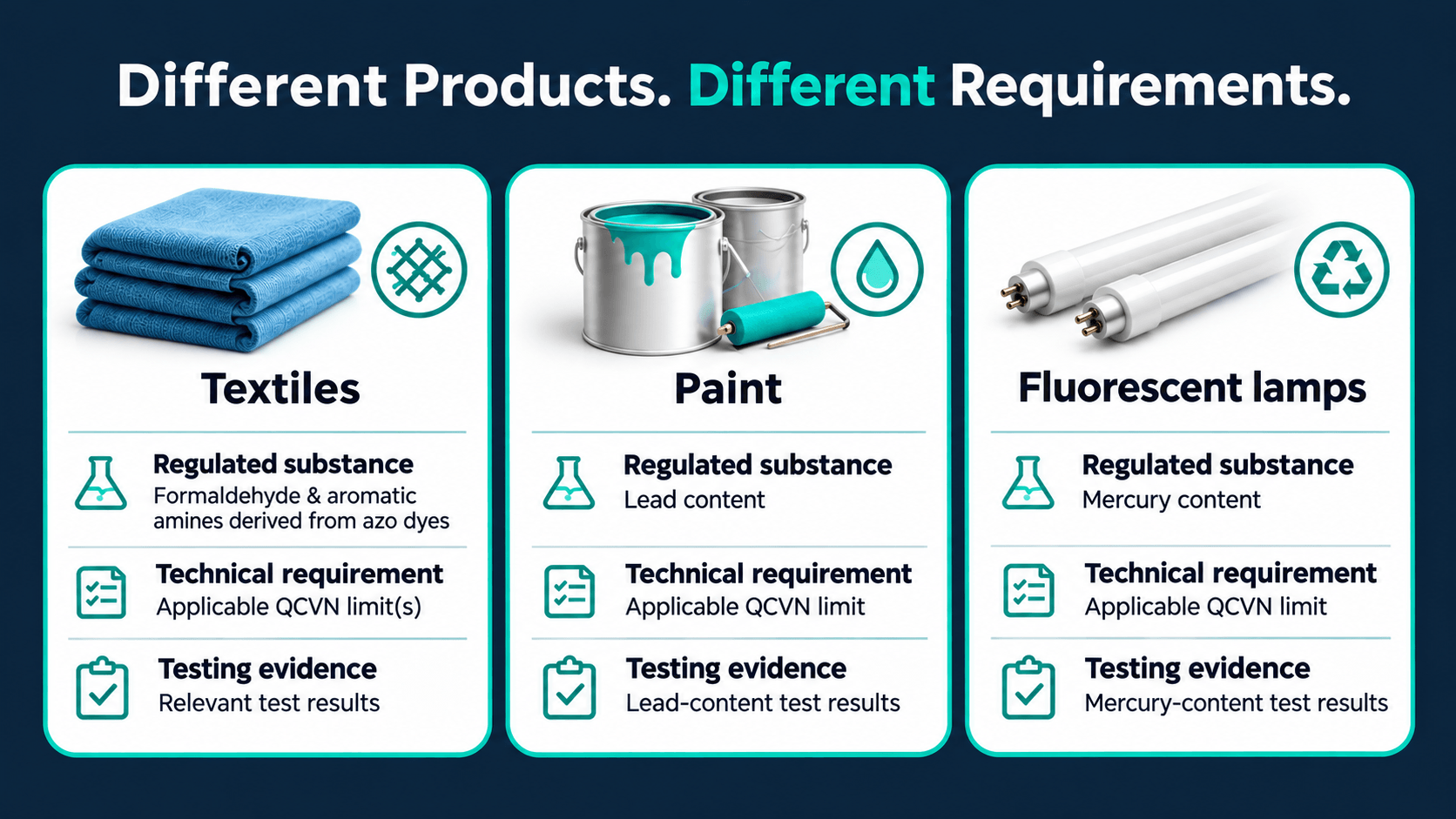
For example, Circular 37/2026/TT-BCT, effective from 1 July 2026, amended national technical regulations covering limits on formaldehyde and aromatic amines derived from azo dyes in textile products, mercury content in fluorescent lamps, and lead content in paint.
Those examples demonstrate why a generic compliance checklist is insufficient.
A textile manufacturer and a paint manufacturer may both be operating under Vietnam's overall manufacturing framework, but the evidence they need is fundamentally different.
The organisation needs a mechanism that can answer:
Which technical requirement applies to which product, which test or certificate demonstrates compliance, when was that evidence produced, and what happens when the regulation or product composition changes?
That becomes particularly important when a multinational company maintains hundreds or thousands of SKUs.
Compliance needs to be linked to the actual product portfolio.
Extended Producer Responsibility Creates Another Product Data Requirement
Vietnam's manufacturing compliance landscape also increasingly follows the product beyond the factory gate.
The Environmental Protection Law No. 72/2020/QH14 establishes environmental obligations including Extended Producer Responsibility, while Decree 110/2026/NĐ-CP, effective from 25 May 2026, provides detailed rules concerning producer and importer responsibility for recycling products and packaging and for waste treatment.
For manufacturers and importers, EPR creates a different type of evidence challenge.
Environmental compliance may depend on understanding the products and packaging being placed on the Vietnamese market, their relevant categories and materials, the organisation's role as producer or importer, and the corresponding recycling or waste-treatment responsibilities.
This requires reliable business data.
Product master data, packaging specifications, import information, sales volumes, environmental classifications and supporting recycling evidence may live in different systems and be owned by different teams.
The regulatory requirement may belong to Sustainability or EHS.
The evidence often belongs to ERP, Finance, Procurement, Supply Chain and Product Management.
Again, the issue is not simply whether the company has an environmental policy.
The issue is whether the company can connect the regulatory obligation to the products that create it.
Smart Factories Introduce a Second Compliance Layer
Modern manufacturing is increasingly digital.
Factories now rely on connected production systems, industrial IoT devices, sensors, robotics, manufacturing execution systems, cloud platforms, remote maintenance, vendor access and real-time production analytics.
That creates an additional regulatory dimension.
Vietnam's Data Law, Personal Data Protection Law and new Cybersecurity Law increasingly sit alongside conventional manufacturing regulation.
A production line may generate operational telemetry rather than personal data, while an access-control system may process employee identities or biometrics. CCTV may record workers and visitors. An external equipment vendor may remotely access factory systems. Operational data may be transferred to a regional cloud environment. A machine-learning system may be used for quality inspection or predictive maintenance.
The manufacturing compliance question therefore expands from:
“Is the product compliant?”
to:
“Are the systems and data used to manufacture that product appropriately governed as well?”
This is particularly important for Operational Technology and Industrial IoT environments because production availability, cybersecurity, physical safety and regulatory evidence can become interdependent.
A traceability system is of limited value if its records cannot be trusted.
A quality system is weakened if the underlying production evidence can be altered without appropriate control.
And a connected factory introduces third-party and remote-access risks that did not exist in the same form in traditional manufacturing environments.
Imports, Exports and Customs Connect the Evidence Chain
For internationally integrated manufacturers, the regulatory chain does not stop at the factory boundary.
Vietnam's Customs Law and implementing customs procedures interact with import and export activities, while product traceability rules increasingly incorporate information such as origin, importer identity, customs information and supply-chain events.
Circular 154 provides a particularly clear illustration: specially controlled chemical traceability can incorporate customs declarations and electronic invoice information into the traceability dataset.
This points toward a broader trend.
The same product may appear in:
ERP records, customs documentation, invoices, supplier certificates, quality records, traceability databases, warehouse systems, environmental reports and regulatory submissions.
If those records describe the same product differently, compliance problems emerge.
Good regulatory governance therefore increasingly depends upon consistent master data and evidence across systems.
One Factory, Multiple Regulatory Frameworks
Consider a Nordic manufacturer operating a factory in Vietnam.
The company imports chemical raw materials and components.
Some chemicals are regulated under Vietnam's Chemicals Law. A subset may fall within specially controlled categories requiring enhanced traceability.
The materials are used in production.
Finished products are subject to technical regulations and product-quality requirements. Depending on their risk category, traceability obligations may apply.
Each batch is recorded within the company's ERP and manufacturing system.
Products and packaging placed on the Vietnamese market may create EPR responsibilities.
Warehouse and logistics systems record movement throughout the supply chain.
Factory cameras, employee access systems and connected machinery create personal, operational and cybersecurity data.
Remote engineers from the manufacturer's regional headquarters access equipment for maintenance.
The products are eventually exported or distributed domestically.
This is not a collection of unrelated compliance projects.
It is one manufacturing lifecycle viewed through multiple regulatory frameworks.
That is why operating each requirement in a separate spreadsheet becomes increasingly difficult.
From Certificates to Regulatory Evidence
Traditional manufacturing compliance has often revolved around obtaining a licence, certificate, test result or inspection report.
Those documents remain important.
But Vietnam's direction in 2026 points toward a broader model where companies may also need to demonstrate the events surrounding the product:
who produced or imported it, which batch it belongs to, where materials originated, which standards apply, which conformity evidence exists, how it moved through the supply chain, which hazardous substances were involved, what happened when an incident occurred, and who is responsible for the corresponding regulatory action.
This creates an important distinction between having evidence and being able to govern evidence.
A PDF test certificate stored somewhere on a shared drive is evidence.
A system that knows which product, regulation, obligation, batch, owner and expiry date that certificate relates to is governance.
That distinction will become increasingly important as Vietnam's product-identification and traceability architecture develops.
What Should Manufacturers Do Now?
A practical starting point is to build one operational view of the manufacturing lifecycle rather than launching separate compliance projects for every regulation.
- Map the product portfolio and determine the applicable Vietnamese product categories, HS codes and responsible regulatory authorities.
- Identify medium- and high-risk products and link them to applicable quality and conformity requirements.
- Map technical regulations and standards to actual products and materials rather than maintaining a generic regulatory list.
- Map product and supply-chain data, including suppliers, batches, serial numbers, production events, warehouses, importers and distributors.
- Assess traceability readiness, including Circular 31 requirements and preparation for Decree 372 from 1 January 2027.
- Create a chemical inventory and classify chemicals, hazardous substances and specially controlled chemicals.
- Connect chemical compliance to operational events, including purchase, storage, movement, use, disposal, losses and incidents.
- Map EPR responsibilities to products, packaging, market volumes and supporting environmental evidence.
- Review OT, IIoT and connected-factory systems against applicable cybersecurity, data and personal-data requirements.
- Build a common evidence model connecting regulations, products, processes, systems, suppliers, owners, controls, assessments and supporting records.
The objective is not to create more documentation.
It is to know which documentation matters, what it proves, who owns it and whether it remains current.
Ronni K. Gothard Christiansen
CEO & Technical Privacy Engineer, AesirX.io
About AesirX ComplianceOne
AesirX ComplianceOne is a governance, risk and compliance platform designed to help organisations turn regulatory requirements into operational controls, workflows and evidence.
ComplianceOne's Vietnam regulatory catalog currently contains 137 framework records across all lifecycle statuses, including 107 active frameworks, spanning national laws, implementing decrees, enforcement instruments and sector-specific operational overlays.
For manufacturing organisations, the supported framework catalog includes dedicated coverage for product quality and traceability, product technical regulations, chemicals and hazardous products, Extended Producer Responsibility, specially controlled chemical traceability, logistics and customs, and smart-factory OT/IIoT data-security governance.
The platform helps organisations connect regulatory requirements with the products, processes, systems, data, suppliers, risks, assessments, responsible owners and evidence required to demonstrate compliance.
Instead of maintaining separate spreadsheets for product quality, chemical compliance, traceability, EPR, cybersecurity and data governance, ComplianceOne provides a common governance layer where organisations can understand:
Which regulations apply?
Which products and operations are affected?
What controls and actions are required?
Who is responsible?
What evidence exists?
And where are the remaining gaps?
Forseti AI, the agentic compliance layer within ComplianceOne, works with installed regulatory frameworks to help teams identify applicable requirements, perform assessments, manage remediation and maintain compliance evidence as regulations and operations change.
For manufacturing organisations, this is particularly valuable because regulatory compliance rarely sits inside one department. ComplianceOne provides the shared operational environment connecting Legal, Compliance, Quality, EHS, IT, Security, Supply Chain and Management.
AesirX does not provide legal services or replace legal counsel. We provide the governance technology, regulatory workflows and technical compliance layer that organisations and their legal advisers can use to operationalise applicable requirements.
Learn more: aesirx.io
This article provides a general overview of Vietnam's regulatory environment and should not be considered legal advice. Regulatory obligations depend on the organisation's products, activities, role in the supply chain and applicable sector-specific requirements.


